
In manufacturing, every delayed job, missed delivery date, or production bottleneck often traces back to one common challenge: production scheduling.
As manufacturers face labor shortages, supply chain disruptions, and growing demand for customized products, scheduling has become far more than simply assigning work orders. It has evolved into a strategic function that directly impacts profitability, customer satisfaction, and operational efficiency.
For make-to-order manufacturers, production scheduling software integrated with ERP systems provides the visibility and flexibility needed to adapt quickly while keeping production moving.
Why Production Scheduling Has Become More Complex
Today’s manufacturers operate in an environment that changes constantly.
Production schedules must account for:
- Material availability
- Labor resources
- Machine capacity
- Customer priorities
- Engineering changes
- Supplier delays
Managing these variables manually often leads to missed deadlines, overtime costs, and unnecessary production interruptions.
Modern scheduling tools help manufacturers respond to changes without disrupting the entire operation.
The Cost of Poor Production Scheduling
Inefficient scheduling affects every department.
Common consequences include:
- Missed delivery commitments
- Increased work-in-progress inventory
- Machine downtime
- Excess overtime
- Reduced labor productivity
- Lower customer satisfaction
Over time, these issues erode profitability and make it difficult to scale operations.
Real-Time Scheduling Creates Better Decisions
Production schedules should never be static.
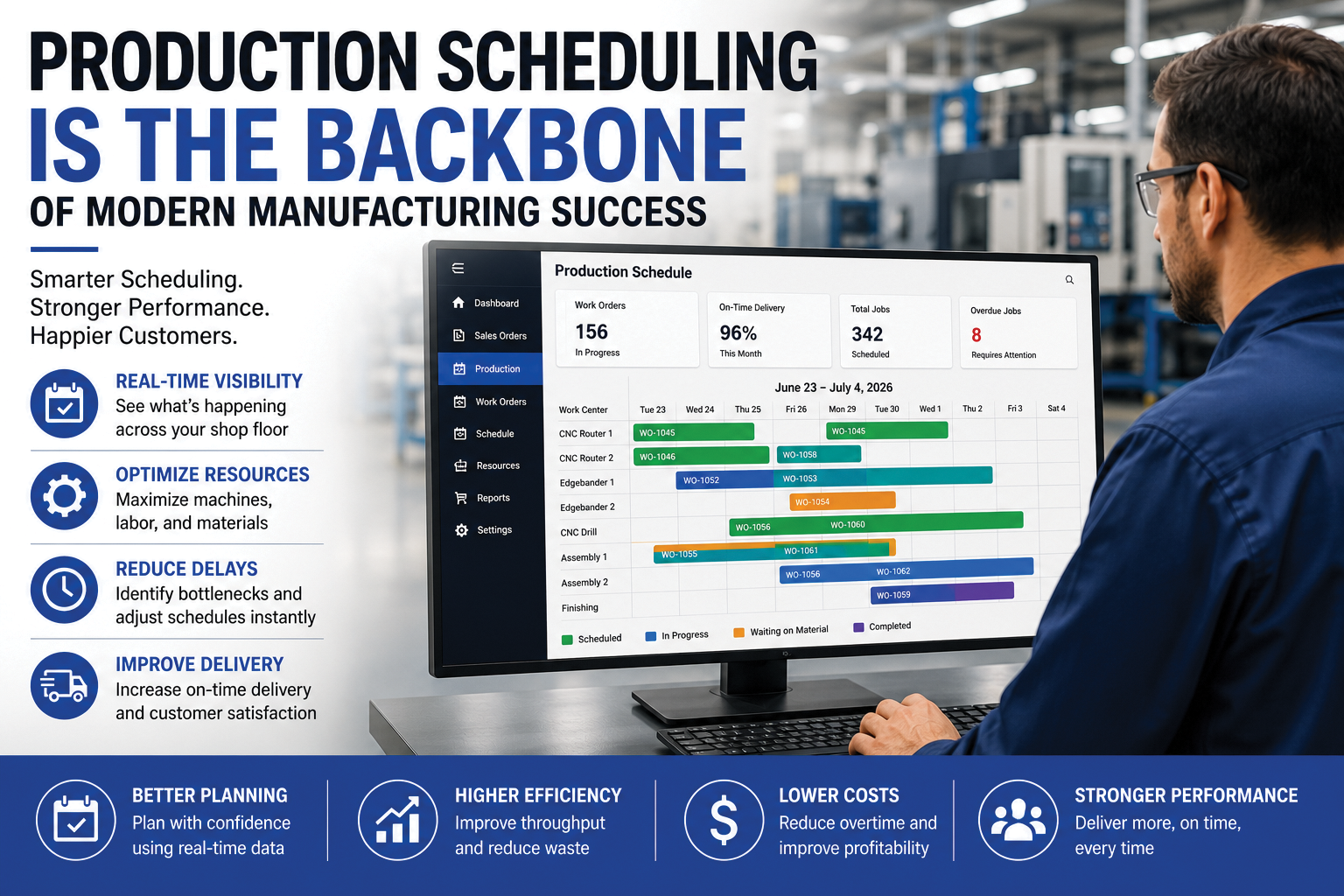
Integrated ERP scheduling solutions provide real-time visibility into:
- Active work orders
- Available materials
- Machine utilization
- Labor capacity
- Production status
When conditions change, manufacturers can immediately adjust schedules based on current operational data instead of outdated reports.
Improving On-Time Delivery
Customers expect reliable delivery dates.
Production scheduling software helps manufacturers:
- Prioritize urgent orders
- Identify bottlenecks before they occur
- Allocate resources more effectively
- Improve production flow
Better scheduling leads directly to improved on-time delivery performance and stronger customer relationships.
Supporting Make-to-Order Manufacturing
Manufacturers producing configurable products often manage hundreds or thousands of unique jobs simultaneously.
Industries such as:
- Cabinet manufacturing
- Millwork
- Door and window manufacturing
- Furniture manufacturing
- Architectural products
require flexible scheduling tools that can accommodate changing customer requirements without sacrificing efficiency.
Integrated scheduling helps balance customization with production capacity.
Better Resource Utilization
Every manufacturing facility has limited resources.
Production scheduling software helps maximize:
- Machine utilization
- Labor productivity
- Work center efficiency
- Material availability
By balancing workloads across departments, manufacturers reduce idle time while improving throughput.
Reducing Production Bottlenecks
Production bottlenecks rarely happen without warning.
Scheduling systems provide visibility into:
- Capacity constraints
- Delayed operations
- Material shortages
- Equipment availability
Managers can proactively address these issues before they affect downstream operations.
ERP Integration Improves Scheduling Accuracy
Disconnected scheduling systems often rely on outdated information.
Integrated ERP scheduling connects directly with:
- Sales orders
- Inventory
- Purchasing
- Engineering
- Production
- Shipping
This creates a single source of truth across the organization and eliminates duplicate data entry.
Data-Driven Production Planning
Modern manufacturers rely on analytics to continuously improve operations.
Scheduling software provides valuable insights into:
- Schedule adherence
- Production efficiency
- Resource utilization
- Delivery performance
- Capacity planning
These metrics help leadership make informed decisions about staffing, equipment investments, and future growth.
How Frontier ERP Supports Production Scheduling
Frontier ERP provides integrated production scheduling capabilities designed specifically for make-to-order manufacturers.
Manufacturers can:
- Schedule production based on real-time inventory
- Balance workloads across work centers
- Monitor production progress
- Improve delivery performance
- Respond quickly to scheduling changes
Because production scheduling is integrated directly with Frontier ERP, manufacturers gain complete visibility across sales, engineering, inventory, and production.
Looking Ahead
Production scheduling will continue to become more dynamic as manufacturers adopt automation, connected equipment, and real-time analytics.
Organizations that invest in integrated scheduling solutions today will be better positioned to:
- Increase throughput
- Improve customer satisfaction
- Reduce operating costs
- Scale production efficiently
Conclusion
Production scheduling is no longer simply an operational task. It is a competitive advantage.
Manufacturers that combine intelligent scheduling with integrated ERP systems gain greater visibility, improve resource utilization, and deliver products more consistently.
For make-to-order manufacturers, modern production scheduling software provides the flexibility needed to succeed in an increasingly complex manufacturing environment.
FAQ
What is production scheduling software?
Production scheduling software helps manufacturers plan, prioritize, and manage work orders while balancing labor, materials, and machine capacity.
Why is production scheduling important?
Effective scheduling improves efficiency, reduces bottlenecks, increases on-time delivery, and helps manufacturers maximize available resources.
How does ERP improve production scheduling?
ERP integrates production schedules with inventory, purchasing, engineering, and customer orders, ensuring schedules are based on real-time operational data.
Which manufacturers benefit most from production scheduling software?
Manufacturers producing configurable or make-to-order products, including cabinet, millwork, furniture, door, and window manufacturers, benefit significantly from integrated production scheduling.