
Manufacturers today are expected to know exactly where every material came from, how every product was built, and when every shipment left the facility.
Whether driven by customer expectations, quality initiatives, or regulatory compliance, manufacturing traceability has become a critical business capability.
For make-to-order manufacturers, traceability is about much more than compliance. It improves quality, strengthens customer relationships, reduces operational risk, and provides valuable insight into production performance.
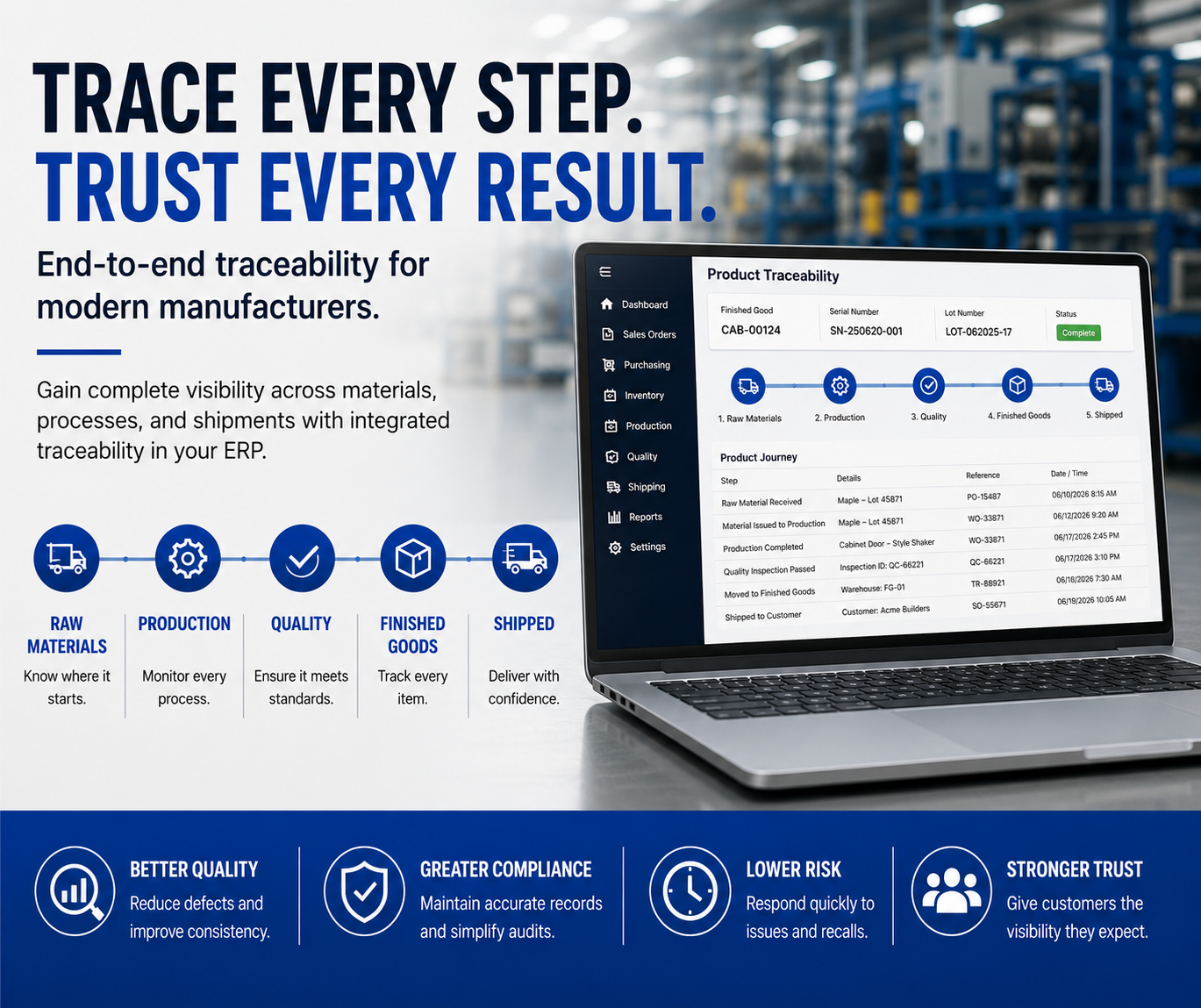
In 2026, manufacturers are increasingly using integrated ERP systems to achieve end-to-end traceability across purchasing, inventory, production, quality control, and shipping.
What Is Manufacturing Traceability?
Manufacturing traceability is the ability to follow materials, components, and finished products throughout every stage of the manufacturing process.
An effective traceability system allows manufacturers to track:
- Raw material receipts
- Supplier information
- Lot and serial numbers
- Production routing
- Work-in-progress
- Quality inspections
- Finished goods
- Customer shipments
This creates complete visibility from supplier to customer.
Why Traceability Matters More Than Ever
Manufacturing operations have become increasingly complex.
Companies must manage:
- Larger supplier networks
- More configurable products
- Higher quality expectations
- Faster production cycles
- Greater customer transparency
Without reliable traceability, identifying the source of production issues becomes time-consuming and expensive.
Integrated ERP systems provide immediate access to historical production data, allowing manufacturers to resolve problems quickly.
Improving Quality Control
Quality problems become significantly easier to manage when manufacturers know exactly where materials and products originated.
Traceability allows teams to:
- Identify defective batches quickly
- Isolate affected products
- Reduce unnecessary recalls
- Improve corrective actions
Instead of investigating thousands of records manually, manufacturers can pinpoint affected orders in minutes.
Supporting Regulatory Compliance
Many industries require manufacturers to maintain accurate production records.
Traceability helps organizations comply with:
- Customer quality requirements
- Industry regulations
- Internal quality standards
- Audit documentation
Accurate electronic records simplify audits while reducing administrative effort.
Better Inventory Management Through Lot Tracking
Traceability is closely connected to inventory management.
Lot and serial tracking provide visibility into:
- Material usage
- Inventory location
- Expiration dates
- Product genealogy
This improves inventory accuracy while reducing waste and obsolescence.
Faster Recall Management
Although every manufacturer hopes recalls never occur, preparation is essential.
Without traceability, recalls often involve:
- Excessive product replacement
- Significant financial loss
- Customer dissatisfaction
With integrated ERP traceability, manufacturers can quickly identify:
- Which materials were affected
- Which customers received impacted products
- Which production runs require investigation
This minimizes disruption while protecting customer relationships.
Improving Customer Confidence
Customers increasingly expect manufacturers to provide transparency throughout the production process.
Traceability allows manufacturers to answer questions such as:
- When was my product manufactured?
- Which materials were used?
- Has quality inspection been completed?
- Where is my order today?
Providing accurate information builds trust and strengthens long-term customer relationships.
Supporting Make-to-Order Manufacturing
Make-to-order manufacturers often deal with unique product configurations that require detailed production records.
Industries such as:
- Cabinet manufacturing
- Millwork
- Door and window manufacturing
- Furniture manufacturing
- Architectural products
benefit significantly from traceability because every order may include unique materials, dimensions, and specifications.
Integrated ERP systems help maintain complete product history throughout production.
Connecting Traceability Across the Business
Traceability is most valuable when every department shares the same information.
Integrated ERP systems connect:
- Purchasing
- Inventory
- Engineering
- Production
- Quality
- Shipping
- Customer Service
This creates a single source of truth, allowing every team to access accurate production history in real time.
Using Traceability Data to Improve Performance
Traceability is not only about looking backward.
The data collected also helps manufacturers:
- Identify recurring quality issues
- Evaluate supplier performance
- Improve production processes
- Reduce waste
- Increase operational efficiency
Historical production information becomes a valuable tool for continuous improvement.
How Frontier ERP Supports Manufacturing Traceability
Frontier ERP helps manufacturers achieve end-to-end visibility by integrating inventory, production, purchasing, quality, and shipping information into a single platform.
Manufacturers can:
- Track lots and serial numbers
- Monitor material movement
- Maintain complete product genealogy
- Improve inventory accuracy
- Support quality management initiatives
Because every transaction occurs within the same ERP environment, traceability becomes faster, more accurate, and easier to manage.
Looking Ahead
As manufacturing continues to evolve, traceability will become an increasingly important competitive advantage.
Organizations that invest in integrated ERP traceability will be better positioned to:
- Improve quality
- Reduce operational risk
- Strengthen compliance
- Enhance customer satisfaction
- Support long-term growth
Conclusion
End-to-end traceability is no longer optional for manufacturers seeking greater operational visibility and quality control.
Integrated ERP systems provide the foundation needed to connect purchasing, production, inventory, and shipping into a complete traceability solution.
For make-to-order manufacturers, stronger traceability leads to better decisions, improved efficiency, and greater customer confidence.
FAQ
What is manufacturing traceability?
Manufacturing traceability is the ability to track materials, components, and finished products throughout the entire manufacturing process.
Why is traceability important?
Traceability improves quality, supports compliance, enables faster recalls, strengthens customer confidence, and provides valuable operational insights.
How does ERP improve traceability?
ERP systems connect purchasing, inventory, production, quality, and shipping data into one platform, providing complete product history and real-time visibility.
Which manufacturers benefit most from traceability?
Manufacturers producing configurable or make-to-order products, including cabinets, millwork, doors, windows, furniture, and architectural products, benefit significantly from integrated traceability.