
Manufacturing organizations have never had more data at their fingertips.
Engineering teams create CAD models and bills of materials. Production captures work orders and machine activity. Purchasing monitors supplier performance, while inventory, shipping, quality, and finance each generate their own valuable information.
The challenge is that this data often lives in separate systems.
The digital thread is changing that.
In 2026, manufacturers are moving beyond simply collecting data. They’re creating connected information flows that link engineering, production, inventory, quality, customer orders, and financial management into a single operational picture. This enables faster decisions, improved collaboration, and greater operational agility.
What Is the Digital Thread?
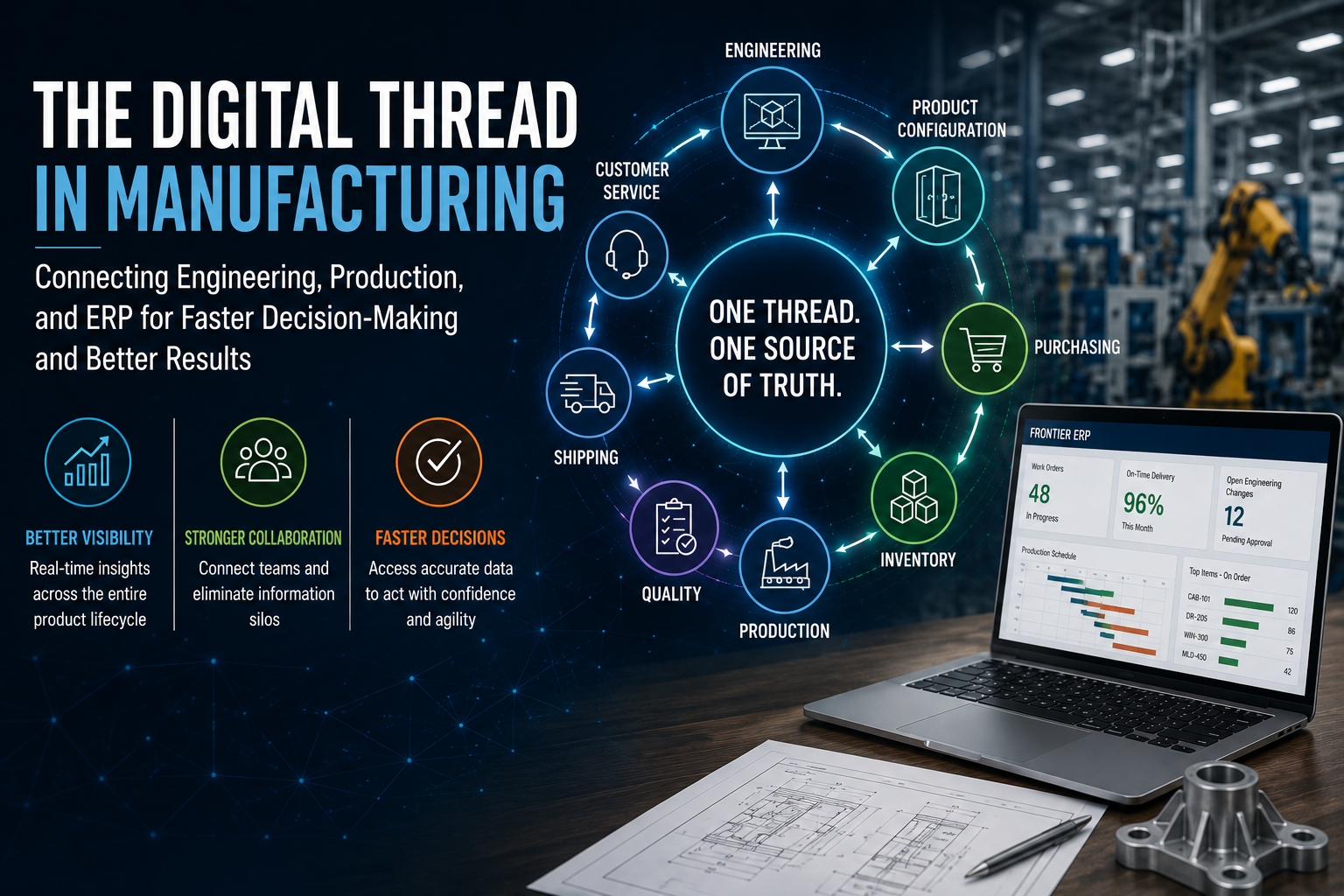
A digital thread is a connected flow of information that follows a product throughout its lifecycle.
Instead of isolated systems and disconnected spreadsheets, the digital thread creates continuity between:
- Product design
- Engineering
- Product configuration
- Purchasing
- Inventory
- Production
- Quality assurance
- Shipping
- Customer service
Every department accesses current information rather than maintaining separate versions of the same data.
Why Manufacturers Are Prioritizing Connected Data
Manufacturing has become significantly more complex.
Today’s companies manage:
- Customized products
- Engineering revisions
- Global supplier networks
- Labor shortages
- Shorter delivery expectations
- Increasing quality requirements
Disconnected information slows decision-making and increases operational risk.
The digital thread allows organizations to move from reactive decision-making to proactive operational management by connecting data across the enterprise.
Breaking Down Information Silos
Many manufacturers still struggle with data trapped inside separate departments.
Engineering has one system.
Production has another.
Finance has its own reports.
Sales relies on spreadsheets.
When these systems don’t communicate, employees spend valuable time searching for information instead of acting on it.
Connected ERP platforms eliminate these silos by providing a single source of operational truth.
Better Collaboration Across Departments
The digital thread improves communication between teams.
When engineering updates a product configuration, purchasing immediately knows which materials are affected.
Production receives updated routing information.
Inventory reflects current requirements.
Sales can confidently communicate delivery expectations.
This connected workflow reduces delays while improving accuracy throughout the organization.
Improving Product Quality
Quality depends on accurate information.
A connected digital thread allows manufacturers to:
- Track engineering revisions
- Monitor production history
- Maintain product genealogy
- Improve traceability
- Identify root causes faster
Rather than investigating quality issues manually, manufacturers can quickly trace products throughout the manufacturing lifecycle.
Faster Engineering Change Management
Engineering changes often affect multiple departments simultaneously.
Without connected systems, outdated drawings or bills of materials can remain in circulation long after revisions have been approved.
Integrated ERP systems help ensure engineering changes flow automatically into:
- Production planning
- Inventory
- Purchasing
- Scheduling
- Customer orders
This reduces costly mistakes while accelerating product updates.
Supporting Smarter Decision-Making
The value of connected data extends beyond operations.
Manufacturers can combine information from across the organization to support:
- Production planning
- Inventory optimization
- Capacity planning
- Financial forecasting
- Customer service
- Executive dashboards
Leadership gains visibility into the entire business rather than isolated departments.
Why Make-to-Order Manufacturers Benefit the Most
Manufacturers producing configurable products operate in environments where change happens constantly.
Industries such as:
- Cabinet manufacturing
- Architectural millwork
- Door and window manufacturing
- Furniture manufacturing
must coordinate engineering revisions, production schedules, inventory availability, and customer requirements every day.
The digital thread provides the visibility necessary to manage this complexity while maintaining efficiency.
How Frontier ERP Supports Connected Manufacturing
Frontier ERP helps manufacturers establish the operational foundation needed for a connected digital thread.
By integrating:
- Product configuration
- Engineering
- Production scheduling
- Inventory management
- Purchasing
- Quality
- Financial management
- Customer order management
Frontier ERP provides manufacturers with a unified platform where information flows across departments instead of remaining isolated.
This allows teams to collaborate more effectively, respond faster to change, and make decisions using real-time operational data.
Looking Ahead
Industry analysts increasingly view connected manufacturing as the next stage of digital transformation.
The future isn’t simply about collecting more data.
It’s about making that data actionable.
Organizations that establish connected information flows today will be better positioned to adopt advanced technologies such as predictive analytics, AI-assisted decision-making, and digital twins while improving productivity and resilience.
Conclusion
The digital thread is transforming how manufacturers operate.
By connecting engineering, production, inventory, quality, and ERP data, manufacturers gain the visibility needed to improve collaboration, accelerate decision-making, reduce errors, and deliver better customer outcomes.
For make-to-order manufacturers, connected information is becoming one of the strongest competitive advantages in modern manufacturing.
FAQ
What is the digital thread in manufacturing?
The digital thread is a connected flow of information that links engineering, production, inventory, quality, shipping, and ERP data throughout the product lifecycle.
Why is the digital thread important?
It improves collaboration, reduces information silos, strengthens traceability, accelerates engineering changes, and enables faster, data-driven decisions.
How does ERP support the digital thread?
ERP systems provide a centralized platform that connects business processes and operational data across departments, creating a single source of truth.
Which manufacturers benefit most from the digital thread?
Manufacturers producing configurable or make-to-order products, including cabinet, millwork, door, window, furniture, and architectural product manufacturers, benefit significantly from connected manufacturing data.