
Introduction
For decades, spreadsheets have been a staple tool in manufacturing operations. They are flexible, familiar, and easy to implement. However, as manufacturing becomes increasingly complex, spreadsheets are reaching their limits.
In 2026, manufacturers are under pressure to improve visibility, reduce errors, accelerate decision-making, and support increasingly customized production environments. Many organizations are discovering that spreadsheets can no longer provide the level of control and real-time information needed to compete effectively.
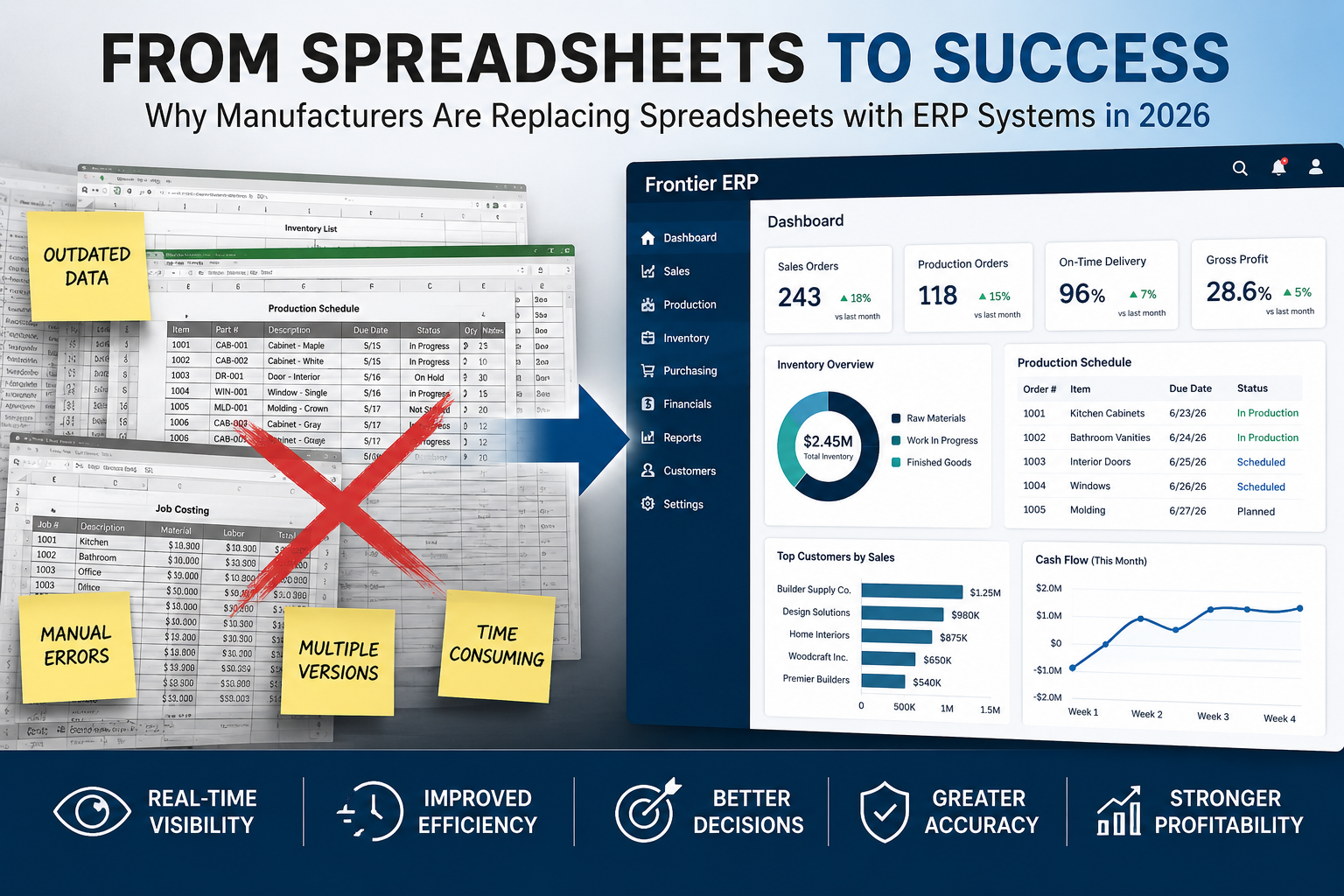
As a result, manufacturers across industries are replacing spreadsheet-based processes with integrated ERP systems that provide a single source of truth for operations, inventory, production, financials, and customer management.
The Hidden Costs of Spreadsheet Dependency
Spreadsheets often appear inexpensive on the surface, but they create significant hidden costs throughout the organization.
Common challenges include:
- Duplicate data entry
- Version control issues
- Manual reporting processes
- Data accuracy concerns
- Limited collaboration
- Slow decision-making
As businesses grow, these challenges multiply and can impact productivity, customer satisfaction, and profitability.
Manufacturers often spend countless hours reconciling spreadsheets rather than analyzing and acting on business data.
Why Manufacturing Complexity Is Increasing
Today’s manufacturers face more complexity than ever before.
They must manage:
- Customized products
- Variable lead times
- Multiple sales channels
- Supply chain disruptions
- Labor shortages
- Increased customer expectations
Industries such as:
- Cabinet manufacturing
- Millwork manufacturing
- Door and window manufacturing
- Furniture manufacturing
often deal with thousands of product variations and configuration options.
Managing this complexity through spreadsheets becomes increasingly difficult and risky.
ERP Systems Provide a Single Source of Truth
One of the biggest advantages of ERP software is centralization.
Rather than storing information across dozens or hundreds of spreadsheets, ERP systems provide one integrated platform for:
- Sales
- Purchasing
- Inventory
- Production
- Financial management
- Customer service
This ensures everyone works from the same information and reduces the risk of conflicting data.
Real-Time Visibility Improves Decision-Making
Spreadsheets are often outdated the moment they are created.
ERP systems provide real-time visibility into:
- Inventory levels
- Production status
- Customer orders
- Financial performance
- Purchasing activity
This allows managers and executives to make decisions based on current information rather than historical snapshots.
In fast-moving manufacturing environments, this visibility can significantly improve responsiveness and operational performance.
Eliminating Manual Processes
Many spreadsheet-driven workflows rely heavily on manual data entry.
ERP systems automate routine activities such as:
- Order processing
- Inventory updates
- Production scheduling
- Financial reporting
- Purchasing workflows
Automation reduces errors, improves efficiency, and frees employees to focus on more strategic work.
Improving Inventory Accuracy
Inventory management is one of the areas where spreadsheet limitations become most apparent.
Without real-time updates, manufacturers often experience:
- Inventory discrepancies
- Stockouts
- Excess inventory
- Expedited purchasing costs
ERP systems help maintain accurate inventory records by automatically updating inventory transactions as they occur.
This improves planning accuracy and helps reduce carrying costs.
Supporting Make-to-Order Manufacturing
Make-to-order manufacturers face unique challenges that spreadsheets are poorly equipped to handle.
ERP systems support:
- Product configuration management
- Dynamic pricing
- Bill of materials generation
- Production scheduling
- Engineering change management
These capabilities help manufacturers scale customization while maintaining operational efficiency.
Strengthening Financial Control
Financial data stored in spreadsheets often requires extensive reconciliation and validation.
ERP financial systems provide:
- Real-time reporting
- Automated accounting processes
- Improved audit trails
- Better forecasting capabilities
This enables finance teams to close books faster, improve accuracy, and gain deeper visibility into profitability.
Enhancing Customer Experience
Customers expect faster responses, accurate delivery dates, and consistent communication.
ERP systems improve customer service by providing:
- Real-time order visibility
- Accurate inventory information
- Faster quote generation
- Improved order accuracy
The result is a better customer experience and stronger long-term relationships.
Why Digital Transformation Starts with ERP
Digital transformation initiatives often fail when organizations attempt to automate disconnected processes.
ERP systems serve as the foundation for:
- Automation
- Business intelligence
- Product configuration management
- eCommerce integration
- Dealer portals
- Real-time analytics
Manufacturers that establish a strong ERP foundation are better positioned to leverage future technologies and innovations.
How Frontier ERP Helps Manufacturers Move Beyond Spreadsheets
Frontier ERP is designed specifically for make-to-order manufacturers.
The platform helps manufacturers:
- Centralize business processes
- Improve operational visibility
- Reduce manual work
- Support configurable products
- Connect sales, production, inventory, and finance
By replacing spreadsheets with an integrated ERP system, manufacturers gain greater control, accuracy, and scalability.
Looking Ahead
The role of spreadsheets in manufacturing is changing.
While spreadsheets will continue to serve as useful analytical tools, they are no longer sufficient as primary operational systems.
Manufacturers that continue relying on spreadsheet-driven processes may find it increasingly difficult to keep pace with competitors that leverage integrated ERP platforms.
Conclusion
In 2026, manufacturers need more than disconnected spreadsheets to manage growing complexity.
ERP systems provide the visibility, automation, and control necessary to improve efficiency, reduce risk, and support long-term growth.
For make-to-order manufacturers, replacing spreadsheets with an integrated ERP platform is one of the most impactful steps toward operational excellence and digital transformation.
FAQ
Why are manufacturers replacing spreadsheets with ERP systems?
Manufacturers are replacing spreadsheets because ERP systems provide real-time visibility, automation, better data accuracy, and improved operational efficiency.
What are the biggest risks of spreadsheet-based manufacturing management?
Common risks include manual errors, outdated information, duplicate data entry, version control problems, and limited scalability.
How does ERP improve manufacturing operations?
ERP integrates inventory, production, purchasing, financials, and customer management into a single system, improving visibility and decision-making.
Which manufacturers benefit most from ERP software?
Manufacturers producing configurable or make-to-order products such as cabinets, millwork, doors, windows, furniture, and specialty products benefit significantly from ERP systems.