
In today’s manufacturing environment, financial management is no longer confined to the accounting department. Every purchasing decision, production schedule, inventory adjustment, and customer order has a direct impact on profitability.
As manufacturers face rising costs, supply chain uncertainty, and increasing customer expectations, financial visibility has become more important than ever. This is why many companies are investing in integrated ERP financial systems that connect accounting, operations, inventory, production, and sales into a single platform.
In 2026, manufacturers that can access real-time financial information are better positioned to improve profitability, reduce risk, and make smarter business decisions. Integrated ERP financial systems help transform financial data from a historical reporting tool into a strategic business asset.
What Are ERP Financial Systems?
ERP financial systems are integrated software solutions that combine traditional accounting functions with operational data from across the organization.
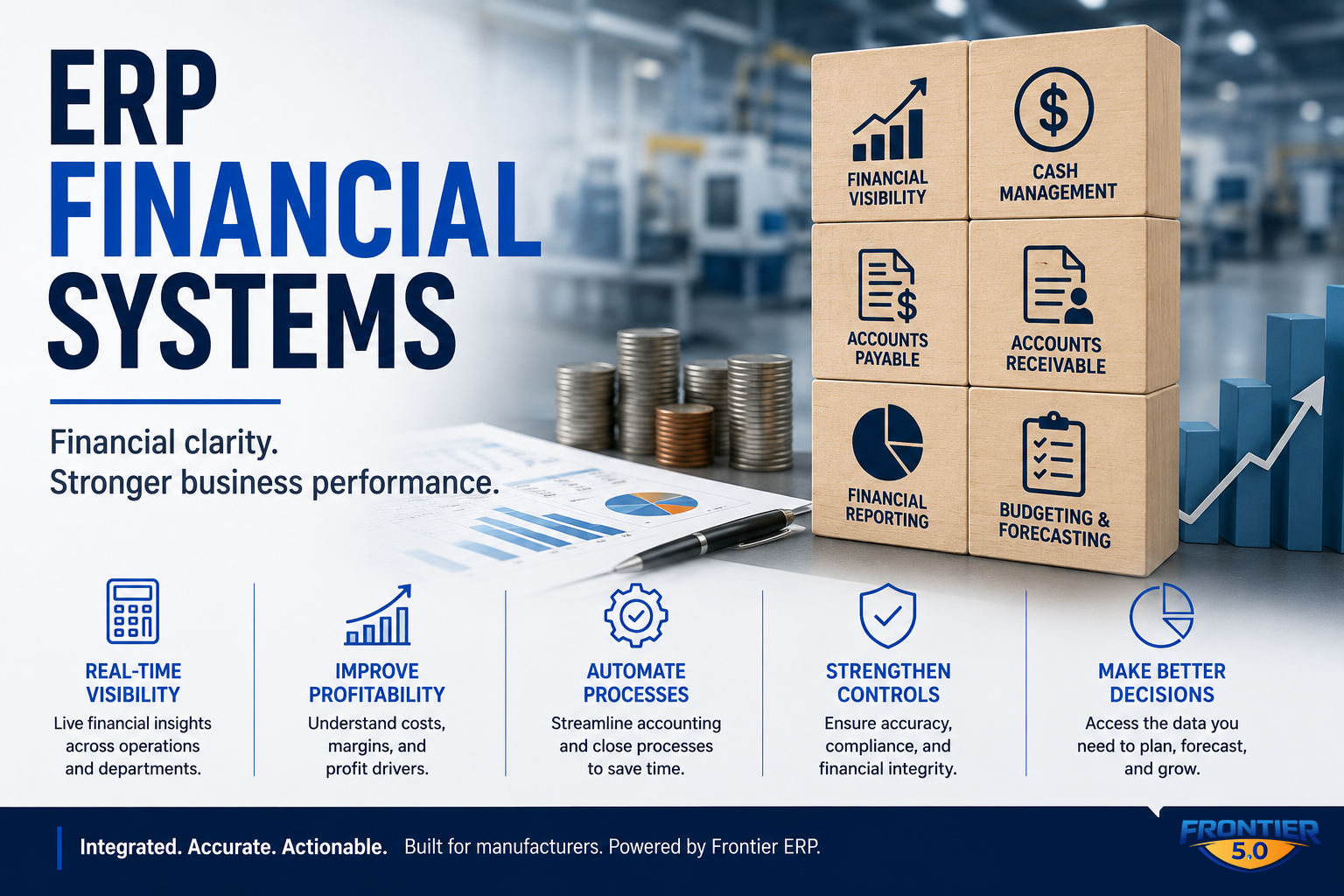
Core financial capabilities typically include:
- General ledger management
- Accounts payable
- Accounts receivable
- Cash management
- Fixed asset tracking
- Financial reporting
- Budgeting and forecasting
- Cost accounting
Unlike standalone accounting software, ERP financial systems connect financial transactions directly to manufacturing activities, providing a complete view of business performance.
Why Manufacturers Need Real-Time Financial Visibility
Many manufacturers still rely on separate accounting systems, spreadsheets, and manual reporting processes.
These disconnected systems often create:
- Data silos
- Reporting delays
- Duplicate data entry
- Limited operational visibility
- Increased risk of errors
Integrated ERP financial systems provide a single, real-time source of financial information that enables leadership teams to make faster and more informed decisions. Frontier ERP emphasizes real-time visibility into profits, costs, revenue, cash flow, and other key financial metrics.
Connecting Operations and Financial Performance
One of the biggest advantages of an integrated ERP financial system is the ability to connect operational activities directly to financial outcomes.
Manufacturers can see how:
- Production efficiency impacts profitability
- Inventory levels affect working capital
- Purchasing decisions influence margins
- Customer activity impacts revenue growth
This holistic view allows executives to move beyond simple accounting reports and gain a deeper understanding of overall business performance.
Improving Financial Reporting Accuracy
Accurate financial reporting is essential for decision-making, compliance, and long-term planning.
Integrated ERP systems improve reporting by:
- Eliminating manual data transfers
- Reducing reconciliation errors
- Providing real-time financial updates
- Automating report generation
Instead of waiting for month-end reports, manufacturers gain immediate access to critical financial information whenever they need it.
Automating Accounting Processes
Manual accounting processes consume valuable time and often introduce unnecessary errors.
ERP financial systems automate tasks such as:
- Invoice generation
- Accounts payable processing
- Account reconciliation
- Expense tracking
- Financial close procedures
Automation helps reduce administrative overhead while improving both speed and accuracy. Frontier ERP specifically highlights streamlined account reconciliation and faster financial closings as major benefits of integrated financial management.
Enhancing Cash Flow Management
Cash flow remains one of the most important metrics for manufacturing success.
Integrated ERP financial systems help manufacturers:
- Monitor receivables and payables
- Improve collections processes
- Forecast cash requirements
- Manage working capital more effectively
Real-time financial visibility allows businesses to identify potential cash flow challenges before they become serious issues.
Supporting Better Strategic Planning
Manufacturers operate in increasingly complex and competitive environments.
Financial leaders need accurate information to support decisions regarding:
- Capital investments
- Product pricing
- Capacity expansion
- Resource allocation
- Growth initiatives
Integrated ERP financial systems provide advanced reporting, forecasting, and scenario planning tools that support long-term strategic decision-making.
Strengthening Compliance and Financial Controls
Manufacturers face growing regulatory and compliance requirements.
ERP financial systems help improve compliance by:
- Maintaining accurate audit trails
- Standardizing financial processes
- Supporting internal controls
- Improving financial transparency
Automated workflows reduce the likelihood of errors while ensuring consistent financial governance throughout the organization.
Why Make-to-Order Manufacturers Benefit Most
Make-to-order manufacturers often face unique financial challenges due to:
- Complex product configurations
- Variable production costs
- Custom pricing structures
- Dynamic inventory requirements
Industries such as:
- Cabinet manufacturing
- Millwork manufacturing
- Door and window manufacturing
- Furniture manufacturing
benefit significantly from integrated ERP financial systems because they require real-time visibility into both operational and financial performance.
How Frontier ERP Supports Financial Management
Frontier ERP integrates financial management directly with manufacturing operations.
This integration enables manufacturers to:
- Access real-time financial data
- Analyze operational and financial performance together
- Improve forecasting accuracy
- Automate accounting workflows
- Gain visibility into profitability drivers
By connecting finance with production, inventory, purchasing, and sales, Frontier ERP helps manufacturers make more informed business decisions while reducing administrative complexity.
Looking Ahead
As manufacturing becomes increasingly data-driven, financial systems will play a larger role in operational success.
Manufacturers that invest in integrated ERP financial systems today will be better positioned to:
- Improve profitability
- Increase efficiency
- Strengthen financial controls
- Scale operations effectively
Those relying on disconnected accounting systems may find it increasingly difficult to compete in a rapidly evolving market.
Conclusion
ERP financial systems have evolved far beyond basic accounting software.
In 2026, integrated financial management is essential for manufacturers seeking better visibility, stronger decision-making, and improved profitability.
By connecting financial and operational data in a single platform, manufacturers gain the insight needed to manage growth, control costs, and respond more effectively to changing business conditions.
For make-to-order manufacturers, an integrated ERP financial system provides the foundation for long-term success.
FAQ
What is an ERP financial system?
An ERP financial system integrates accounting, reporting, budgeting, and financial management with operational data from across the organization.
Why is financial integration important in manufacturing?
Financial integration provides real-time visibility into costs, profitability, inventory, production, and business performance, helping manufacturers make better decisions.
How does ERP improve financial reporting?
ERP systems automate data collection and reporting, reducing errors and providing real-time financial insights.
What manufacturers benefit most from ERP financial systems?
Make-to-order manufacturers such as cabinet, millwork, door, window, and furniture manufacturers benefit significantly from integrated financial management.