
Inventory has always been one of the most valuable assets in manufacturing. Yet many manufacturers still struggle with delayed inventory updates, disconnected systems, and limited visibility into material availability.
In 2026, real-time inventory visibility is emerging as a significant competitive advantage. Manufacturers that can accurately track inventory across purchasing, production, warehousing, and shipping are improving operational efficiency, reducing costs, and delivering a better customer experience.
For make-to-order manufacturers, where production schedules depend heavily on material availability, inventory visibility has become a critical component of business success.
What Is Real-Time Inventory Visibility?
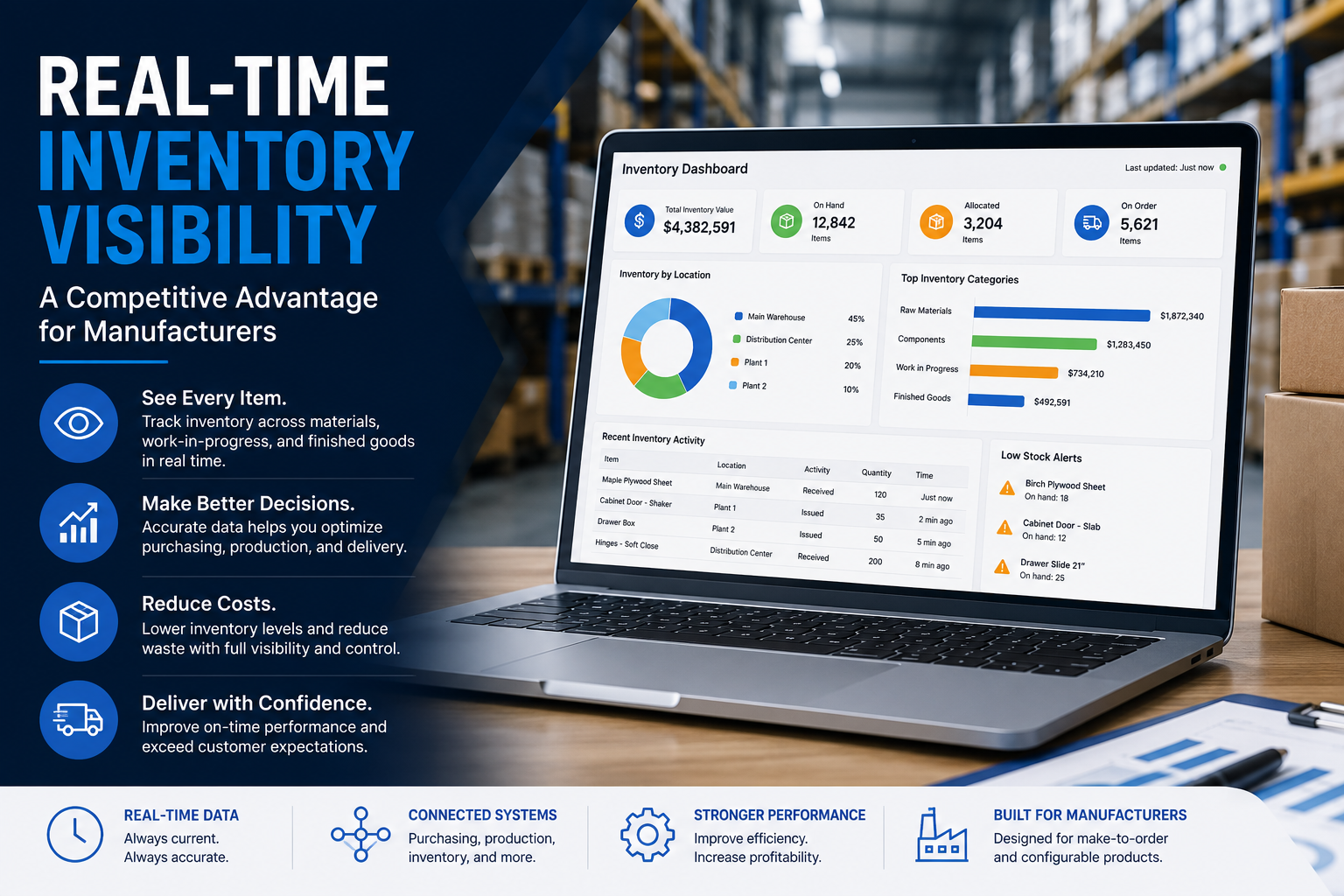
Real-time inventory visibility refers to the ability to monitor inventory levels, movements, and availability across the organization as transactions occur.
Rather than relying on periodic updates or manual inventory counts, manufacturers gain immediate access to information about:
- Raw materials
- Work-in-progress inventory
- Finished goods
- Purchased components
- Inventory locations
- Incoming shipments
This level of visibility helps eliminate uncertainty and enables faster, more informed decision-making.
Why Inventory Visibility Matters More Than Ever
Manufacturers continue to face challenges such as:
- Supply chain disruptions
- Material shortages
- Longer lead times
- Rising carrying costs
- Increasing customer expectations
Without accurate inventory information, companies often respond by purchasing excess materials or carrying larger safety stock levels.
While this may reduce shortages, it increases inventory costs and ties up working capital.
Real-time visibility allows manufacturers to balance inventory availability with financial efficiency.
Improving Production Scheduling
Production schedules are only as accurate as the inventory data supporting them.
When inventory records are outdated:
- Jobs may be delayed unexpectedly
- Production resources sit idle
- Expedited purchasing becomes necessary
- Customer delivery dates are impacted
Real-time inventory visibility enables planners to make scheduling decisions based on current material availability, reducing surprises and improving throughput.
Reducing Inventory Carrying Costs
Excess inventory represents hidden costs throughout the organization.
These costs include:
- Storage expenses
- Obsolescence risk
- Insurance costs
- Capital tied up in stock
Manufacturers with better inventory visibility can:
- Optimize inventory levels
- Reduce over-purchasing
- Improve turnover rates
- Free up working capital
This creates a healthier balance sheet while improving operational performance.
Supporting Make-to-Order Manufacturing
Manufacturers producing configurable products often deal with thousands of possible product combinations.
Industries such as:
- Cabinet manufacturing
- Millwork manufacturing
- Door and window manufacturing
- Furniture production
require precise inventory management to support customization.
Real-time inventory visibility ensures that production teams know exactly what materials are available before work begins.
This reduces delays and improves order fulfillment accuracy.
Improving Customer Service
Today’s customers expect accurate delivery dates and proactive communication.
Inventory visibility allows manufacturers to:
- Provide realistic lead times
- Respond quickly to order inquiries
- Identify potential delays early
- Improve on-time delivery performance
The result is a stronger customer experience and increased customer confidence.
The Role of ERP in Inventory Visibility
Modern ERP systems serve as the foundation for real-time inventory management.
An integrated ERP system connects:
- Purchasing
- Inventory
- Production
- Shipping
- Financial reporting
This creates a single source of truth for inventory information across the organization.
When inventory data updates in real time, every department operates using the same information.
Automation and Inventory Accuracy
Manual inventory processes remain a common source of errors.
Automation improves accuracy by:
- Recording transactions automatically
- Updating inventory balances instantly
- Tracking material movements
- Reducing data entry mistakes
These improvements increase confidence in inventory records and reduce the need for manual reconciliation.
Why Inventory Visibility Supports Digital Transformation
Digital transformation initiatives often focus on automation, analytics, and operational efficiency.
Inventory visibility supports these goals by providing:
- Better operational insights
- More accurate reporting
- Improved forecasting
- Faster decision-making
Manufacturers that invest in inventory visibility create a stronger foundation for future technology initiatives.
How Frontier ERP Supports Inventory Visibility
Frontier ERP helps manufacturers achieve real-time inventory visibility through integrated inventory management capabilities.
Manufacturers can:
- Monitor inventory across locations
- Track material usage in real time
- Improve purchasing decisions
- Connect inventory data with production schedules
By centralizing inventory information, Frontier ERP helps manufacturers improve efficiency and reduce operational risk.
Looking Ahead
Inventory visibility will continue to play a larger role in manufacturing performance over the coming years.
Manufacturers that invest in real-time inventory management today will be better positioned to:
- Reduce costs
- Improve customer service
- Increase efficiency
- Scale operations effectively
Those relying on manual processes and disconnected systems may find it increasingly difficult to compete.
Conclusion
Real-time inventory visibility is no longer just an operational improvement. It is becoming a strategic advantage.
Manufacturers that gain accurate, real-time insight into inventory levels can improve scheduling, reduce costs, and deliver a better customer experience.
As manufacturing becomes increasingly data-driven, inventory visibility will remain a critical component of long-term success.
FAQ
What is real-time inventory visibility?
Real-time inventory visibility is the ability to track inventory levels, movements, and availability as transactions occur throughout the organization.
Why is inventory visibility important in manufacturing?
It helps manufacturers improve scheduling, reduce inventory costs, avoid shortages, and provide more accurate delivery commitments.
How does ERP improve inventory visibility?
ERP systems connect purchasing, production, inventory, and shipping into a single platform, providing real-time inventory information across the business.
Which manufacturers benefit most from inventory visibility?
Make-to-order manufacturers such as cabinet, millwork, door, window, furniture, and configurable product manufacturers benefit significantly from improved inventory visibility.