

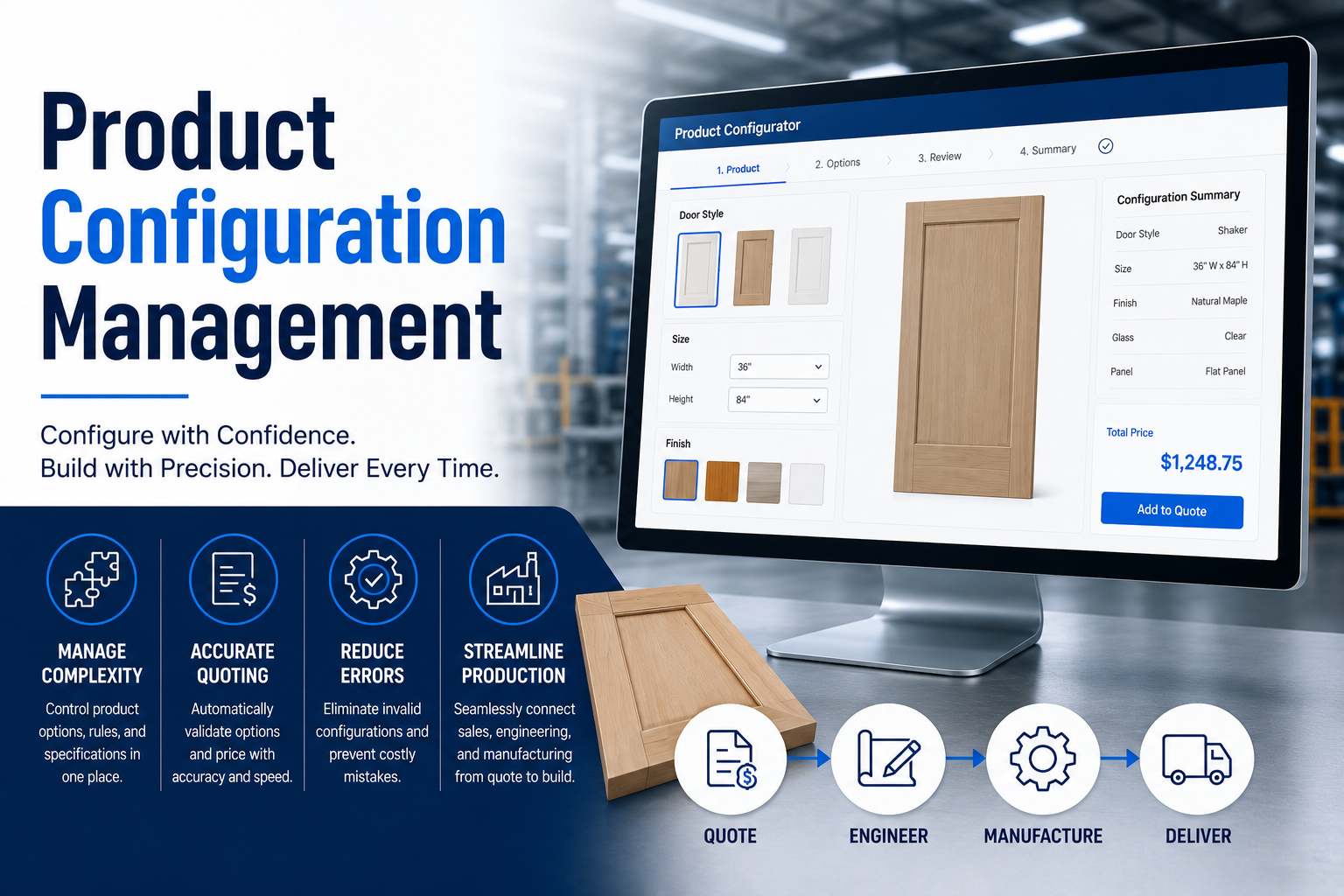
Manufacturers producing configurable products face increasing pressure to deliver customized solutions faster, more accurately, and with fewer operational errors.
In industries such as cabinetry, millwork, doors, windows, furniture, and other make-to-order manufacturing environments, managing product complexity has become one of the biggest operational challenges.
That is why more manufacturers are investing in product configuration management systems that connect sales, engineering, production, and pricing into a unified workflow.
In 2026, effective product configuration management is no longer just a sales tool. It is a critical component of operational efficiency, quoting accuracy, and long-term scalability.
What Is Product Configuration Management?
Product configuration management is the process of controlling how products, options, rules, pricing, and specifications are defined and managed throughout the organization.
For manufacturers, this includes:
- Product options and variations
- Configuration rules
- Pricing structures
- Engineering specifications
- Manufacturing requirements
Rather than relying on spreadsheets or tribal knowledge, configuration management centralizes product intelligence and ensures consistency across all departments.
Why Product Complexity Is Increasing
Customer demand for customization continues to grow.
Manufacturers now offer:
- More product options
- More finishes and materials
- More sizing variations
- More customer-specific configurations
While these options create sales opportunities, they also increase operational complexity.
Without structured configuration management:
- Quoting errors increase
- Production mistakes become more common
- Engineering workloads expand
- Lead times grow longer
Managing this complexity efficiently has become a competitive advantage.
Improving Quote Accuracy and Speed
One of the biggest benefits of product configuration management is faster and more accurate quoting.
Modern configuration systems help sales teams:
- Automatically validate product options
- Prevent incompatible selections
- Generate accurate pricing instantly
- Reduce quote turnaround times
This allows manufacturers to respond faster to customer inquiries while maintaining confidence in pricing and product feasibility.
Reducing Production Errors
Configuration mistakes often create costly downstream problems.
When incorrect product specifications reach production:
- Material waste increases
- Rework costs rise
- Delivery schedules are disrupted
- Customer satisfaction declines
Product configuration management ensures that approved configurations flow directly into manufacturing processes, reducing the risk of manual interpretation errors.
Connecting Sales and Manufacturing
Many manufacturers struggle because sales and production operate from different information sources.
Configuration management creates alignment by ensuring:
- Sales teams use approved configurations
- Engineering requirements are built into product rules
- Production receives accurate specifications
- Pricing reflects real manufacturing requirements
This creates a more efficient workflow from quote to delivery.
Supporting Make-to-Order Manufacturing
Make-to-order manufacturers benefit more than almost any other industry from product configuration management.
These environments require:
- Flexible product options
- Dynamic pricing
- Complex engineering rules
- Accurate bill of materials generation
Configuration systems help manufacturers handle customization without sacrificing efficiency.
Industries benefiting most include:
- Cabinet manufacturing
- Millwork manufacturing
- Door and window manufacturing
- Furniture manufacturing
- Glass and metal fabrication
Automating Product Rules and Logic
Modern product configuration management systems automate decision-making through predefined rules.
This allows manufacturers to:
- Eliminate invalid configurations
- Standardize product offerings
- Reduce dependency on manual review
- Improve consistency across sales channels
Automation helps ensure every order meets operational and engineering requirements before reaching production.
Improving Customer Experience
Customers increasingly expect faster responses and accurate product information.
Configuration management supports this by:
- Reducing quote delays
- Improving order accuracy
- Providing clearer product options
- Delivering more consistent customer experiences
The result is greater confidence throughout the buying process.
Product Configuration and Digital Transformation
As manufacturers continue investing in digital transformation, product configuration management plays a central role.
It supports:
- ERP integration
- Online quoting systems
- Dealer ordering platforms
- Automated workflows
- Real-time pricing updates
By centralizing product intelligence, manufacturers create a stronger foundation for automation and scalability.
How Frontier Supports Product Configuration Management
Frontier ERP provides manufacturers with integrated product configuration capabilities designed specifically for make-to-order environments.
The platform helps manufacturers:
- Manage complex product rules
- Automate pricing and quoting
- Support configurable products
- Connect sales, engineering, and production
Because configuration management is integrated directly into Frontier ERP, manufacturers gain a single source of truth across the organization.
This reduces duplication, improves visibility, and helps ensure operational consistency.
Why Product Configuration Management Matters in 2026
Manufacturers can no longer rely on disconnected systems or manual processes to manage growing product complexity.
Product configuration management helps businesses:
- Improve accuracy
- Increase efficiency
- Reduce operational risk
- Scale customization profitably
As customer expectations continue to rise, manufacturers with strong configuration processes will be better positioned to compete.
Conclusion
In 2026, product configuration management is becoming a foundational capability for make-to-order manufacturers.
By connecting product rules, pricing, engineering requirements, and production workflows, manufacturers can improve efficiency while delivering highly customized products with confidence.
For businesses looking to reduce errors, accelerate quoting, and support long-term growth, product configuration management is one of the most important investments they can make.