
For make-to-order manufacturers, accurate costing has always been important—but in 2026, it’s becoming mission-critical.
With ongoing material price volatility, labor constraints, and increasing demand for customization, manufacturers can no longer rely on static pricing models or delayed cost analysis. Instead, they are turning to real-time costing capabilities within their ERP systems to maintain margins, improve quoting accuracy, and stay competitive.
Whether you’re producing cabinets, doors, windows, furniture, or other custom-built products, real-time cost visibility is quickly becoming a foundational requirement—not just a competitive advantage.
The Problem with Traditional Costing Methods
Many manufacturers still rely on outdated costing approaches:
- Static price lists that don’t reflect current material costs
- Spreadsheet-based estimating processes
- Delayed job costing analysis after production is complete
- Limited visibility into labor and overhead allocation
These methods create risk. When costs shift between quote and production—as they often do—manufacturers can unknowingly erode margins or even take on unprofitable jobs.
In a make-to-order environment, where every job is different, this lack of visibility compounds quickly.
Why Real-Time Costing Matters in 2026
1. Material Price Volatility Is the New Normal
Fluctuations in lumber, metals, hardware, and other inputs continue to impact manufacturers across industries.
Real-time costing allows companies to:
- Update pricing dynamically as material costs change
- Ensure quotes reflect current market conditions
- Avoid margin loss due to outdated cost assumptions
2. Customization Increases Cost Complexity
Make-to-order manufacturers deal with unique configurations on nearly every job.
Without real-time costing:
- Estimating becomes inconsistent
- Errors increase
- Profitability varies widely between jobs
With integrated ERP systems, manufacturers can automatically calculate costs based on configuration, materials, routing, and labor—ensuring every quote is accurate.
3. Faster Quoting Wins More Business
Speed matters. Customers often compare multiple vendors before making a decision.
Real-time costing enables:
- Faster quote turnaround
- Greater confidence in pricing
- Reduced back-and-forth between departments
Manufacturers that respond quickly—with accurate pricing—have a clear advantage.
How ERP Systems Enable Real-Time Costing
Modern ERP platforms are designed to connect every aspect of the manufacturing process, making real-time costing possible.
Integrated Data Across Departments
ERP systems unify:
- Sales and quoting
- Engineering and configuration
- Production and scheduling
- Purchasing and inventory
This ensures cost calculations are based on live operational data, not outdated estimates.
Automated Job Costing
Instead of manually tracking costs, ERP systems:
- Capture labor and material usage in real time
- Allocate overhead automatically
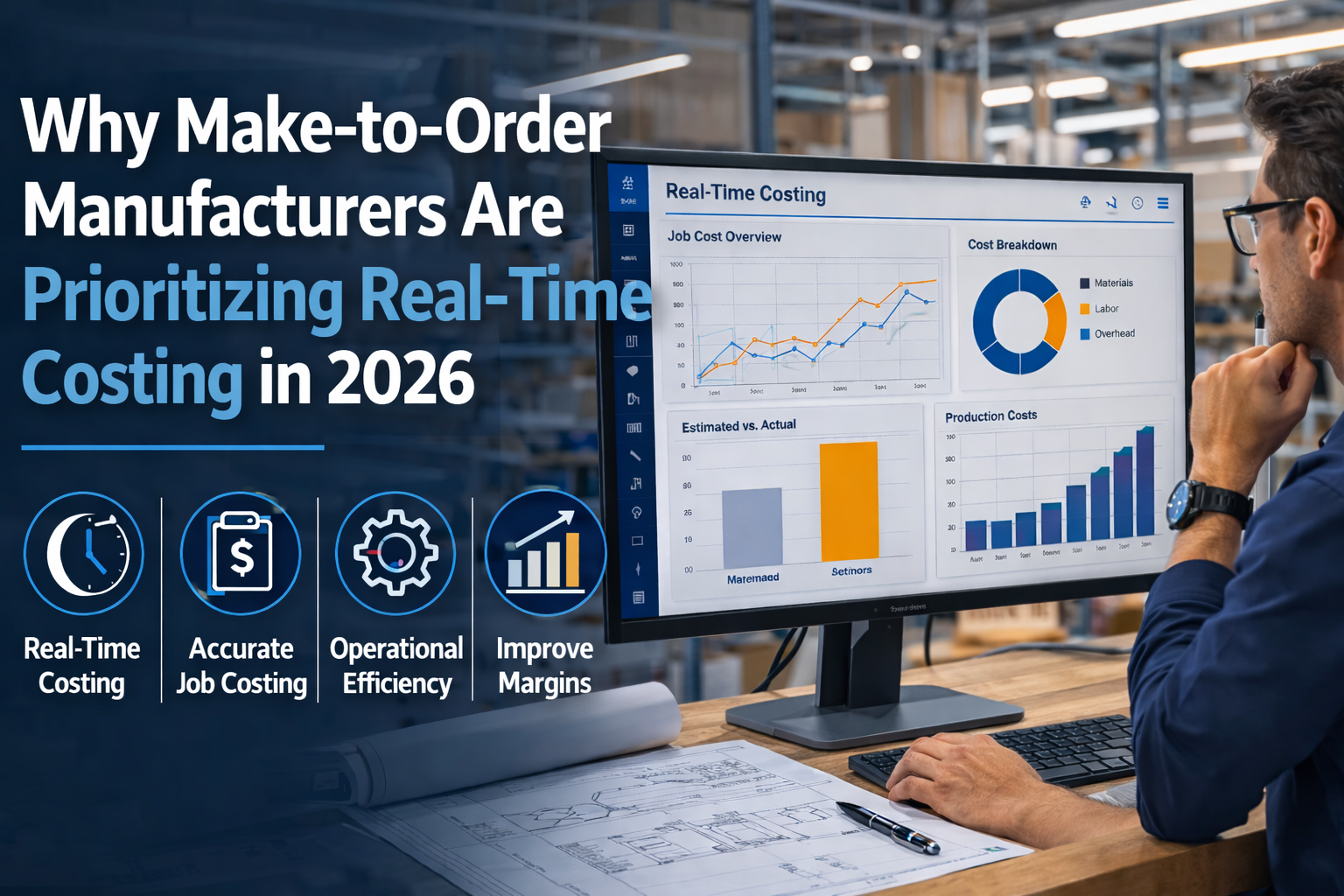
- Compare estimated vs. actual costs
This provides immediate insight into job profitability.
Dynamic Pricing Capabilities
With real-time data, manufacturers can:
- Adjust pricing based on cost changes
- Maintain consistent margins
- Respond quickly to market conditions
The Impact on Profitability and Decision-Making
Real-time costing doesn’t just improve accuracy—it transforms how manufacturers operate.
Improved Margin Control
Manufacturers can identify:
- Which jobs are most profitable
- Where costs are increasing
- Opportunities for efficiency improvements
Better Operational Decisions
With accurate cost data, teams can:
- Optimize production schedules
- Improve purchasing strategies
- Reduce waste and inefficiencies
Increased Confidence Across Teams
Sales, operations, and finance all work from the same data—reducing friction and improving collaboration.
Why Make-to-Order Manufacturers Are Leading This Shift
Industries such as:
- Cabinet and millwork manufacturing
- Door and window production
- Furniture manufacturing
- Glass and metal fabrication
are leading the adoption of real-time costing because of their high variability and customization.
In these environments, even small inaccuracies in cost estimation can significantly impact profitability.
How Frontier ERP Supports Real-Time Costing
For manufacturers operating in complex, make-to-order environments, Frontier ERP provides:
- Integrated product configuration and quoting
- Real-time material and labor cost tracking
- Automated job costing and variance analysis
- Unified data across sales, production, and finance
By connecting operational workflows with financial insight, manufacturers gain the visibility needed to make faster, more informed decisions.
Looking Ahead
As manufacturing continues to evolve, real-time costing will become a standard capability rather than a differentiator.
Manufacturers that adopt these tools now will be better positioned to:
- Maintain profitability in volatile markets
- Improve customer responsiveness
- Scale operations without increasing risk
Those who continue relying on outdated costing methods may find it increasingly difficult to compete.
Conclusion
In 2026, real-time costing is no longer optional for make-to-order manufacturers—it’s essential.
By leveraging ERP systems that provide accurate, real-time cost visibility, manufacturers can improve margins, streamline operations, and win more business.
For companies looking to stay competitive in an increasingly complex market, investing in real-time costing capabilities is one of the most impactful steps they can take.
FAQ
Why is real-time costing important for manufacturers?
Real-time costing ensures that pricing reflects current material, labor, and overhead costs. This helps manufacturers maintain margins, avoid pricing errors, and make better operational decisions.
How does ERP software improve job costing?
ERP systems automate data collection across production, inventory, and labor, providing accurate cost tracking and real-time visibility into job profitability.
What industries benefit most from real-time costing?
Make-to-order industries such as cabinet manufacturing, millwork, doors and windows, furniture, and metal fabrication benefit the most due to high customization and cost variability.
Can small manufacturers benefit from real-time costing?
Yes. Even small manufacturers can improve efficiency, reduce errors, and increase profitability by adopting ERP systems with real-time costing capabilities.