
The metal construction industry is heading to Orlando, and Frontier ERP.will be there
From October 7–9, 2026, contractors, manufacturers, fabricators, architects, engineers, suppliers, installers, and other industry professionals will gather at the Orange County Convention Center for METALCON 2026.
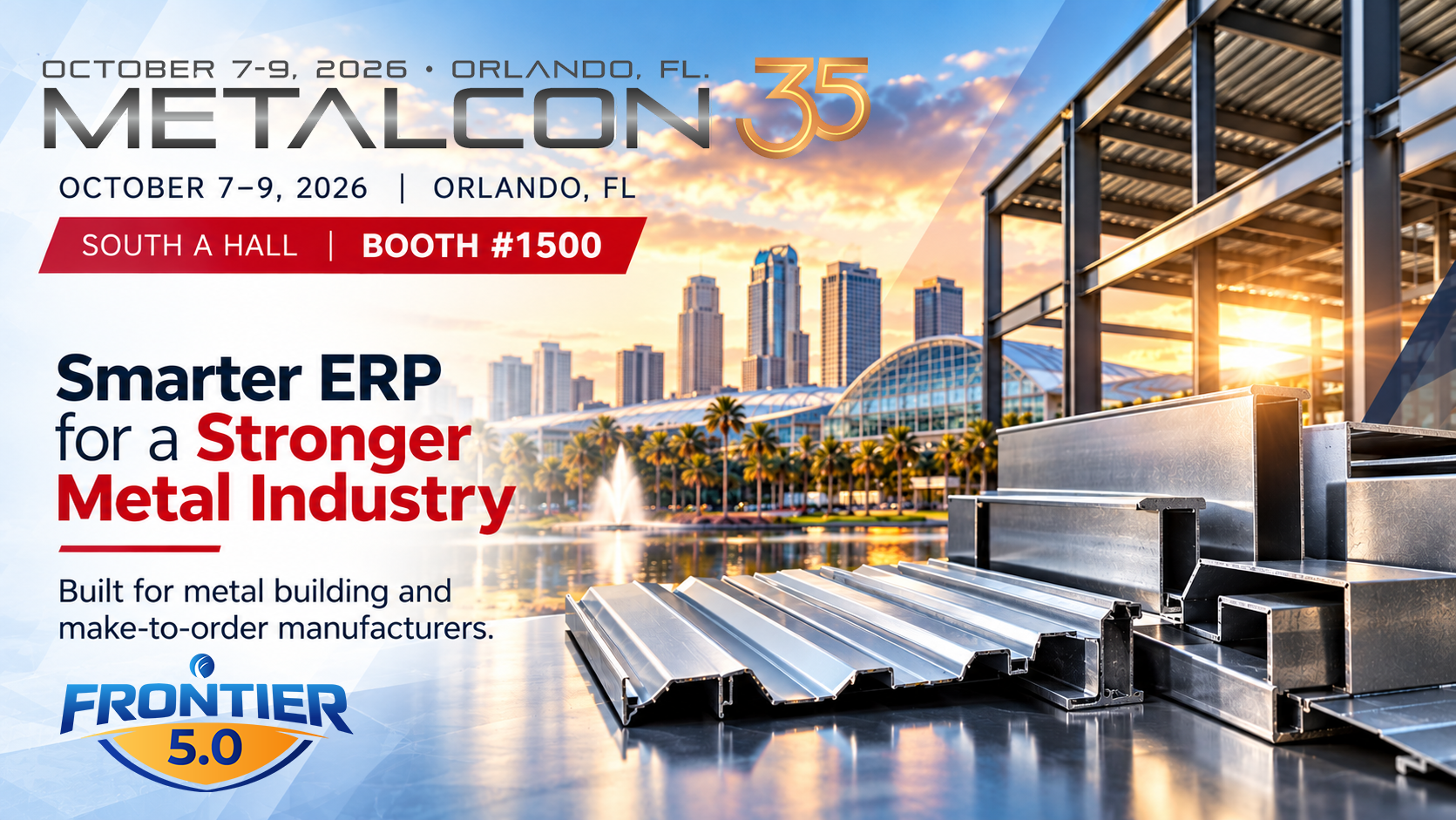
If you’re attending, visit Frontier ERP at Booth #1500 in Hall South A. METALCON
METALCON is celebrating its 35th anniversary this year and remains the only annual event dedicated exclusively to the application of metal in design and construction. The 2026 event brings together more than 250 exhibitors and programming covering changing technology, building codes, workforce challenges, performance requirements, design, fabrication, and construction. METALCON
For Friedman Corporation, the show provides an opportunity to discuss a challenge that increasingly affects complex manufacturers:
How do you manage greater product complexity without creating greater operational complexity?
That’s where manufacturing ERP can make a difference.
Metal Manufacturing Is Becoming More Complex
Metal building and component manufacturers don’t operate in simple production environments.
Customer requirements can vary by:
- Dimensions
- Materials
- Profiles
- Gauges
- Colors and finishes
- Components
- Engineering specifications
- Building requirements
- Customer-specific options
Every change can affect estimating, engineering, purchasing, inventory, scheduling, production, shipping, and financial performance.
When those functions rely on separate systems, spreadsheets, and manual communication, complexity grows quickly.
An integrated ERP for metal building manufacturers can help connect these processes through a common operational platform.
1. Manage Complex Product Configuration
Configurable products are difficult to manage manually.
A change in dimensions may affect material requirements.
A different component may change pricing.
An engineering selection may affect production.
A customer option may create additional manufacturing steps.
Rules-based product configuration helps manufacturers encode this product knowledge into the system.
Instead of employees manually determining whether every combination is valid, configuration rules can help determine:
- Which options are compatible
- Which materials are required
- How a product should be priced
- Which components are needed
- What manufacturing instructions apply
- Whether engineering requirements have been satisfied
For complex make-to-order manufacturers, product configuration can become the connection between what a customer wants and what production needs to build.
2. Connect Estimating and Quoting With Manufacturing
A quote shouldn’t become an entirely new project when the customer places the order.
Yet that happens when estimating and manufacturing operate from disconnected information.
A connected process can help move information through:
Configuration → Pricing → Quote → Order → Engineering → Production
This reduces the need to recreate information after a sale.
For manufacturers managing highly configurable products, that can help:
- Improve quote accuracy
- Accelerate response times
- Reduce manual calculations
- Improve order accuracy
- Reduce engineering effort
- Create a smoother transition into production
The goal isn’t simply faster quoting.
It’s creating a more efficient path from opportunity to manufactured product.
3. Improve Production Scheduling
Metal manufacturing environments can involve multiple work centers, machines, fabrication processes, assembly operations, and competing priorities.
Scheduling those resources effectively becomes increasingly difficult as product complexity grows.
Manufacturers need visibility into:
- Open orders
- Available capacity
- Material availability
- Production priorities
- Due dates
- Work center loads
- Current production status
Integrated production scheduling helps manufacturers coordinate these variables instead of managing schedules through isolated spreadsheets.
When conditions change, planners can make decisions using current operational information.
4. Improve Material and Inventory Visibility
Material represents a significant investment for manufacturers.
Too little inventory can stop production.
Too much inventory ties up working capital.
And inaccurate inventory creates problems throughout the organization.
Manufacturing ERP helps connect inventory with:
- Customer orders
- Purchasing
- Bills of materials
- Production requirements
- Work orders
- Shipping
This provides a clearer picture of what material is available, what has already been committed, and what needs to be purchased.
Better visibility can help manufacturers reduce shortages while controlling unnecessary inventory.
5. Reduce Manual Processes Between Departments
Some of the most expensive inefficiencies in manufacturing don’t happen at the machine.
They happen between departments.
Sales sends an email.
Engineering updates a spreadsheet.
Purchasing checks another application.
Production receives printed paperwork.
Customer service calls someone on the floor for an update.
Finance reconciles the information later.
Each step may seem manageable individually.
Together, they create significant administrative work.
Integrated ERP provides a shared source of information across:
Sales → Engineering → Purchasing → Inventory → Scheduling → Production → Shipping → Financials
Reducing these information handoffs can improve productivity without simply adding headcount.
6. Gain Better Production Visibility
Manufacturers shouldn’t have to wait until the end of a shift to understand what happened.
Operational visibility can help teams monitor:
- Work orders
- Production progress
- Material usage
- Bottlenecks
- Order status
- Inventory
- Delivery performance
That information becomes especially valuable when schedules change or problems occur.
Instead of discovering an issue after a customer order becomes late, teams can identify problems earlier and respond while there is still time to act.
7. Connect Manufacturing Data
Modern manufacturers increasingly operate with a collection of specialized technologies.
ERP.
Engineering software.
Production equipment.
Customer applications.
Business intelligence.
Shipping systems.
Financial applications.
Automation.
The challenge isn’t necessarily acquiring more technology.
It’s connecting the technology already in use.
When systems remain isolated, employees often become responsible for moving information between them manually.
A connected manufacturing strategy helps reduce those silos and creates a stronger operational data foundation.
8. Build a Foundation for Automation and AI
Automation and AI are becoming increasingly relevant throughout manufacturing and construction.
But advanced technology depends on something fundamental:
Reliable data.
AI and analytics need accurate information about:
- Customers
- Products
- Materials
- Orders
- Production
- Inventory
- Costs
- Delivery performance
Manufacturers with fragmented operational information may find that their first AI project needs to be a data integration project.
ERP can help provide the business context that makes advanced analytics and automation more useful.
Why ERP Matters for Metal Building Manufacturers
Metal building and component manufacturers frequently operate somewhere between standard manufacturing and highly customized production.
That makes flexibility essential.
An ERP platform should be able to support the way products are actually sold, configured, engineered, manufactured, and delivered.
For manufacturers evaluating technology at METALCON, useful questions include:
Can the system manage our actual product complexity?
Can customer configurations flow directly into downstream manufacturing processes?
Can production see accurate material availability?
Can scheduling respond when priorities change?
How much information are employees still entering manually?
Can management see what’s happening without waiting for a report?
Can the platform integrate with the technologies we already use?
Those questions are often more valuable than simply comparing feature lists.
Frontier ERP: Built for Complex Manufacturing
Frontier ERP is designed around manufacturers that design, build, modify, configure, or assemble products to order.
The platform connects critical manufacturing and business processes, including:
- Product configuration
- Customer and order management
- Engineering
- Purchasing
- Inventory
- Production scheduling
- Manufacturing operations
- Shipping
- Financial management
- Reporting and business intelligence
For complex manufacturers, the objective is straightforward:
Create one operational environment where information can move with the product.
That reduces friction between departments while helping employees make decisions using consistent information.
One Platform. Smarter Manufacturing. Stronger Business.
Manufacturers don’t need technology simply because it’s new.
They need technology that produces better business outcomes.
That could mean:
- Faster quoting
- Fewer configuration errors
- Better scheduling
- Less manual data entry
- Greater inventory accuracy
- Improved production visibility
- Shorter lead times
- Better customer service
- Stronger margins
That’s the direction behind Frontier 5.0.
One Platform. Smarter Manufacturing. Stronger Business.
The goal is to provide complex manufacturers with a stronger operational foundation for what’s next.
Meet Frontier ERP at METALCON 2026
If you’re attending METALCON this October, make time to meet the Friedman Corporation team and explore Frontier ERP.
METALCON 2026
October 7–9, 2026
Orange County Convention Center
Hall South A | Orlando, Florida
Frontier ERP | Booth #1500
The exhibit hall is scheduled for 10:00 a.m.–5:00 p.m. Wednesday and Thursday and 9:00 a.m.–1:00 p.m. Friday. METALCON
Stop by and talk with us about:
- ERP modernization
- Product configuration
- Make-to-order manufacturing
- Estimating and quoting
- Production scheduling
- Inventory management
- Manufacturing visibility
- Workflow automation
- Data integration
- Business intelligence
- AI readiness
- Frontier 5.0
You don’t need to bring us a software requirements document.
Bring us the manufacturing challenge you’re trying to solve.
That’s the best place to start.
What to Watch at METALCON 2026
Beyond the exhibit floor, this year’s show is addressing many of the forces shaping metal construction, including technology, workforce development, building codes, sustainability, market conditions, performance requirements, and design.
The 2026 program includes more than 35 free accredited education sessions, live demonstrations, training areas, networking programs, and the Design District for architects, designers, specifiers, and engineers. METALCON
For manufacturers, METALCON provides an opportunity not simply to see what’s new, but to evaluate which technologies could make their businesses more productive, connected, and competitive.
Built for What’s Next
The future of metal manufacturing isn’t simply faster equipment.
It’s a more connected business.
Customer requirements need to connect with configuration.
Configuration needs to connect with engineering.
Engineering needs to connect with materials.
Materials need to connect with scheduling.
Scheduling needs to connect with production.
Production needs to connect with shipping and financial information.
When those processes work together, manufacturers can spend less time moving information and more time manufacturing products.
That’s the conversation we’re bringing to Orlando.
We’ll see you at METALCON 2026, Booth #1500.
Frequently Asked Questions
When is METALCON 2026?
METALCON 2026 takes place October 7–9, 2026, at the Orange County Convention Center in Orlando, Florida. METALCON
Where is Frontier ERP exhibiting at METALCON?
The official METALCON 2026 exhibitor list identifies Frontier ERP Software at Booth #1500. METALCON
What is METALCON?
METALCON is an annual event dedicated exclusively to metal design and construction. The show brings together contractors, architects, fabricators, manufacturers, distributors, developers, suppliers, and other industry professionals. METALCON
What is Frontier ERP?
Frontier ERP is Friedman Corporation’s ERP platform for complex manufacturers, particularly organizations producing configurable and make-to-order products.
Why is ERP important for metal manufacturers?
ERP helps connect quoting, product configuration, engineering, materials, purchasing, inventory, scheduling, production, shipping, and financial information so manufacturers can manage complex operations through a more integrated environment.
What can I discuss with Friedman Corporation at METALCON?
Manufacturers can discuss ERP modernization, product configuration, estimating and quoting, production scheduling, inventory management, operational visibility, workflow automation, data integration, and Frontier 5.0.