
Another International Woodworking Fair is in the books.
IWF 2026 brought woodworking manufacturers, machinery providers, software companies, suppliers, and industry professionals together in Atlanta from August 25 through August 28.
For manufacturers, the value of a show like IWF goes well beyond seeing the newest machines.
It provides a window into where the industry is going next.
Across woodworking technology, automation, software, product design, and manufacturing operations, one message continues to become clearer:
The future of woodworking manufacturing is connected.
Manufacturers are no longer evaluating machines, software, ERP, engineering tools, and automation as completely separate investments. They increasingly need these technologies to work together as part of one coordinated manufacturing environment.
Here are six takeaways from IWF 2026 that manufacturers should carry into their technology and operational planning for 2027 and beyond.
1. Automation Is Moving From Individual Machines to Connected Processes
Automation has been part of woodworking manufacturing for decades.
What is changing is the scope.
Manufacturers are increasingly looking beyond automating a single cutting, machining, material handling, or assembly process.
The bigger opportunity is connecting automation across the entire order lifecycle.
That could mean creating a process where information moves from:
Customer Order → Product Configuration → Engineering → Materials → Scheduling → Production → Shipping
with fewer manual steps between each stage.
The distinction matters.
A faster machine can improve one work center.
A connected process can improve how the entire business operates.
For manufacturers evaluating automation investments, the next question should therefore be:
How does this technology connect with everything before and after it?
2. Software-to-Machine Connectivity Is Becoming More Important
One of the most significant technology themes for woodworking manufacturers is the continued integration between software and production equipment.
Traditionally, information might move from an ERP system to engineering, then to manufacturing software, and eventually to a machine through several manual steps.
Every handoff creates an opportunity for:
- Data-entry errors
- Outdated information
- Production delays
- Duplicate work
- Miscommunication
Connected manufacturing reduces those handoffs.
When customer, configuration, engineering, production, and machine information can move through integrated systems, manufacturers create a more continuous digital workflow.
This is particularly valuable for make-to-order manufacturers where every order may contain different:
- Dimensions
- Materials
- Finishes
- Hardware
- Product options
- Manufacturing instructions
The closer manufacturers can connect customer requirements with production execution, the less opportunity there is for information to get lost along the way.
3. Product Configuration Is Becoming Central to Manufacturing Efficiency
Woodworking manufacturers are being asked to provide more choice.
Customers want more styles.
More finishes.
More configurations.
More customization.
And they often expect all of it without significantly longer lead times.
This creates a difficult operational equation.
More product flexibility usually creates more complexity unless manufacturers have a structured way to manage it.
Product configuration technology helps translate customer selections into repeatable business rules.
Those rules can help determine:
- Whether a product combination is valid
- Which components are required
- How the product should be priced
- Which bill of materials applies
- What production instructions are needed
- Which engineering requirements apply
For make-to-order manufacturers, configuration is becoming much more than a quoting tool.
It can become the starting point for the entire manufacturing process.
4. AI Is Getting Attention, but Connected Data Is the Real Foundation
Artificial intelligence continues to become more visible across manufacturing technology.
Potential applications include:
- Estimating
- Forecasting
- Production planning
- Document processing
- Customer service
- Quality analysis
- Engineering assistance
- Business intelligence
Those capabilities are exciting.
But manufacturers should avoid treating AI as a shortcut around more fundamental data challenges.
An AI tool working with incomplete, duplicated, outdated, or disconnected information can only provide limited value.
Before manufacturers ask:
“How can we use AI?”
A better starting question may be:
“Can our systems provide the accurate, connected data AI would need?”
That means connecting information across:
- Customer orders
- Engineering
- Product configuration
- Inventory
- Purchasing
- Production
- Quality
- Shipping
- Finance
The companies that build this foundation now will be better prepared as AI capabilities continue evolving.
5. Productivity Is Becoming More Important Than Simply Adding Capacity
Manufacturers continue to face workforce constraints, cost pressures, and demanding customer expectations.
The response cannot always be:
Add another person. Add another shift. Add another machine.
Increasingly, manufacturers are looking for ways to get more productivity from the resources they already have.
Technology can support that goal by reducing time spent on activities such as:
- Searching for information
- Re-entering data
- Updating spreadsheets
- Manually checking inventory
- Reconciling conflicting reports
- Correcting avoidable errors
- Tracking down order status
- Communicating routine updates between departments
None of these activities directly create customer value.
Every hour eliminated from unnecessary administrative work can potentially be redirected toward production, engineering, customer service, or continuous improvement.
The future of manufacturing productivity is not simply faster equipment.
It is eliminating friction throughout the organization.
6. ERP Is Becoming the Operational Backbone of Connected Manufacturing
The ERP conversation is changing.
Historically, manufacturers may have viewed ERP primarily as a system for processing transactions.
Enter the order.
Create the purchase order.
Update inventory.
Generate the invoice.
Close the month.
Those processes remain essential, but modern manufacturers increasingly expect ERP to do more.
For make-to-order manufacturers, ERP can serve as the operational backbone connecting:
- Sales
- Product configuration
- Engineering
- Purchasing
- Inventory
- Production scheduling
- Manufacturing
- Shipping
- Financial management
- Business intelligence
This shifts ERP from being primarily a system of record to becoming a platform that helps coordinate the operation.
That distinction will become increasingly important as woodworking manufacturers adopt more automation, digital workflows, connected machinery, and advanced analytics.
What IWF 2026 Means for Manufacturers Planning for 2027
Coming back from a major industry event can leave manufacturers with a long list of technologies they would like to explore.
The challenge is deciding what comes first.
Instead of beginning with specific technologies, manufacturers should start by identifying operational friction.
Ask questions such as:
Where do employees enter the same information more than once?
Duplicate data entry is often a sign that systems are not sufficiently connected.
Where does production wait for information?
Delays may indicate an issue with engineering, configuration, material visibility, or departmental communication.
Which processes still depend heavily on spreadsheets?
Spreadsheets can be useful tools, but critical operational processes become difficult to scale when they rely on disconnected files.
Where is tribal knowledge creating risk?
If only one or two employees understand how important products or processes work, manufacturers should look for ways to capture that knowledge systematically.
Which customer interactions remain difficult?
Quoting, product configuration, dealer ordering, order status, and delivery information can all influence customer experience.
Can leadership see what is happening in real time?
Manufacturers should have access to current information about production, inventory, orders, delivery performance, and financial results.
These questions help turn technology planning into operational improvement.
From Digital Transformation to Practical Transformation
Digital transformation has been one of manufacturing’s most frequently used phrases.
But manufacturers do not need technology simply because it is new.
They need technology that solves real problems.
A successful modernization strategy should help an organization:
- Quote faster
- Reduce mistakes
- Improve scheduling
- Increase throughput
- Shorten lead times
- Improve inventory accuracy
- Simplify employee workflows
- Strengthen customer relationships
- Make better decisions
If a technology does not contribute to measurable operational improvement, manufacturers should question why they are implementing it.
The objective is not digital transformation for its own sake.
The objective is a stronger manufacturing business.
What Frontier 5.0 Represents for the Next Generation of Manufacturing ERP
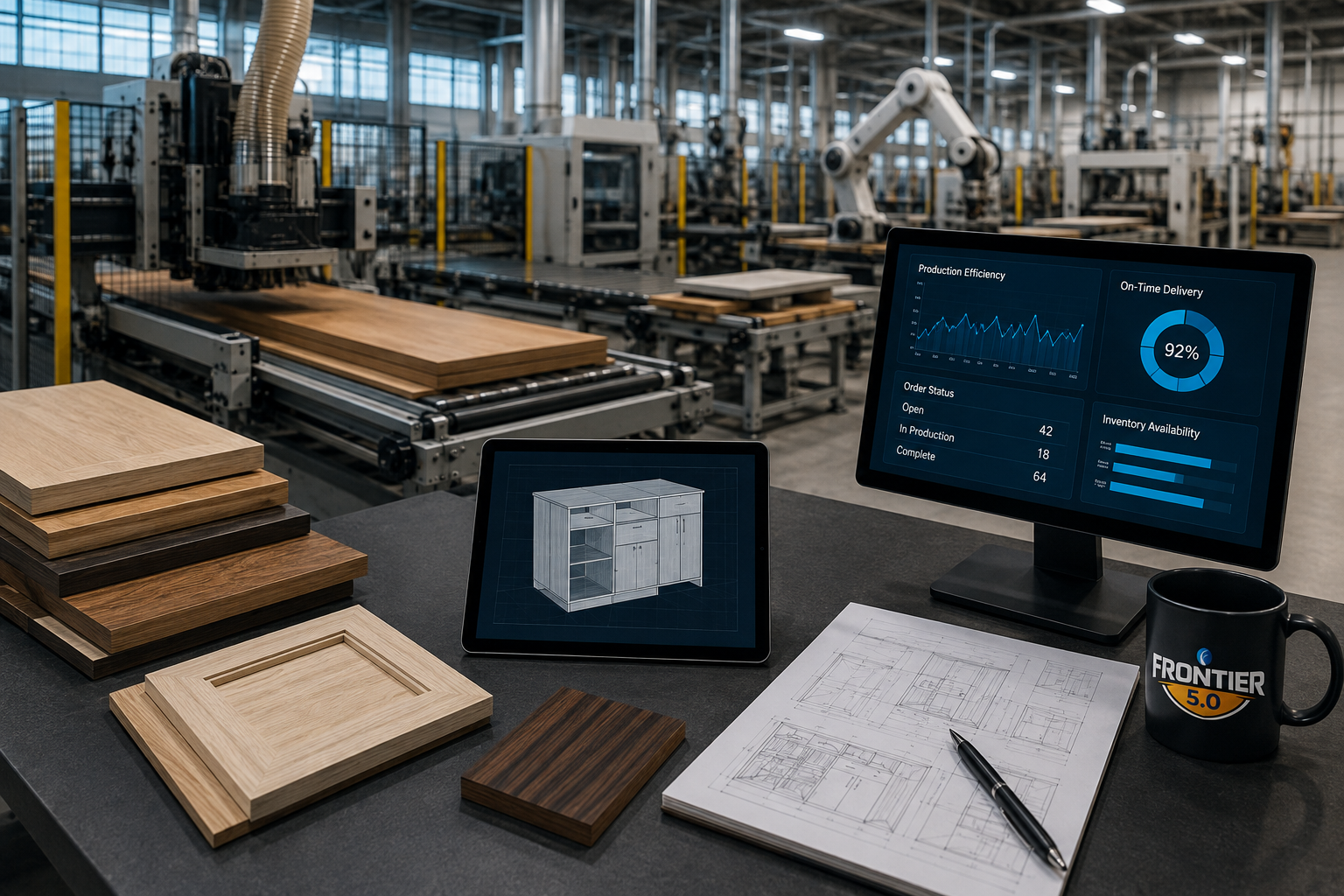
At IWF 2026, Friedman Corporation continued the conversation around the future of Frontier, including the direction of Frontier 5.0.
The underlying idea is straightforward:
One Platform. Smarter Manufacturing. Stronger Business.
Make-to-order manufacturers increasingly need an ERP environment that can support greater product complexity while making everyday processes easier to manage.
That means creating a foundation capable of connecting areas such as:
- Product configuration
- Order management
- Engineering
- Production scheduling
- Inventory
- Purchasing
- Manufacturing operations
- Financial management
- Business intelligence
As manufacturing becomes more connected, the ERP platform becomes increasingly important because it provides the operational context surrounding all of those individual technologies.
IWF Is Over. The Work Starts Now.
The machines are being packed up.
The booths are coming down.
And thousands of attendees have returned home with ideas about what might come next.
But the real value of IWF happens after the show.
It happens when manufacturers take those ideas back to their organizations and ask:
Which changes would actually make our business better?
For some companies, the answer may be automation.
For others, it may be product configuration.
It could be better scheduling.
Improved data integration.
Real-time reporting.
A modern dealer ordering experience.
Or replacing an ERP environment that no longer supports where the organization is headed.
The important part is connecting technology decisions to business outcomes.
Thank You for Connecting With Friedman Corporation at IWF 2026
Thank you to everyone who visited Friedman Corporation during IWF 2026 in Atlanta.
The opportunity to talk directly with manufacturers about their challenges, priorities, and plans for the future is one of the most valuable parts of participating in an industry event.
The show may be over, but those conversations do not have to stop.
If you did not have an opportunity to meet with our team at IWF, or if a conversation at the show raised additional questions, we would be happy to continue the discussion.
Whether you’re considering ERP modernization, product configuration, improved data connectivity, or simply looking for ways to make your manufacturing operation more efficient, the best place to begin is with the challenge you’re trying to solve.
Frequently Asked Questions
What were the major manufacturing technology themes at IWF 2026?
Key themes included automation, software-to-machine connectivity, connected manufacturing, product configuration, AI-enabled applications, improved manufacturing productivity, and greater integration between operational systems.
How is woodworking automation changing?
Automation is increasingly moving beyond individual machines toward connected manufacturing processes that link customer orders, engineering, production planning, machinery, inventory, and shipping.
Why is connected manufacturing important?
Connected manufacturing reduces manual data transfers and information silos while giving employees more accurate and timely information across departments.
What role does ERP play in smart manufacturing?
ERP can provide the operational foundation connecting sales, product configuration, engineering, inventory, purchasing, production, shipping, and financial information.
What is Frontier 5.0?
Frontier 5.0 represents the next direction of Friedman’s ERP platform for complex make-to-order manufacturers, with an emphasis on modern processes, streamlined operations, efficiency, and stronger business performance.
What should manufacturers do after attending IWF?
Manufacturers should identify the most significant areas of operational friction in their businesses and evaluate technology based on its ability to solve those problems and produce measurable improvements.