
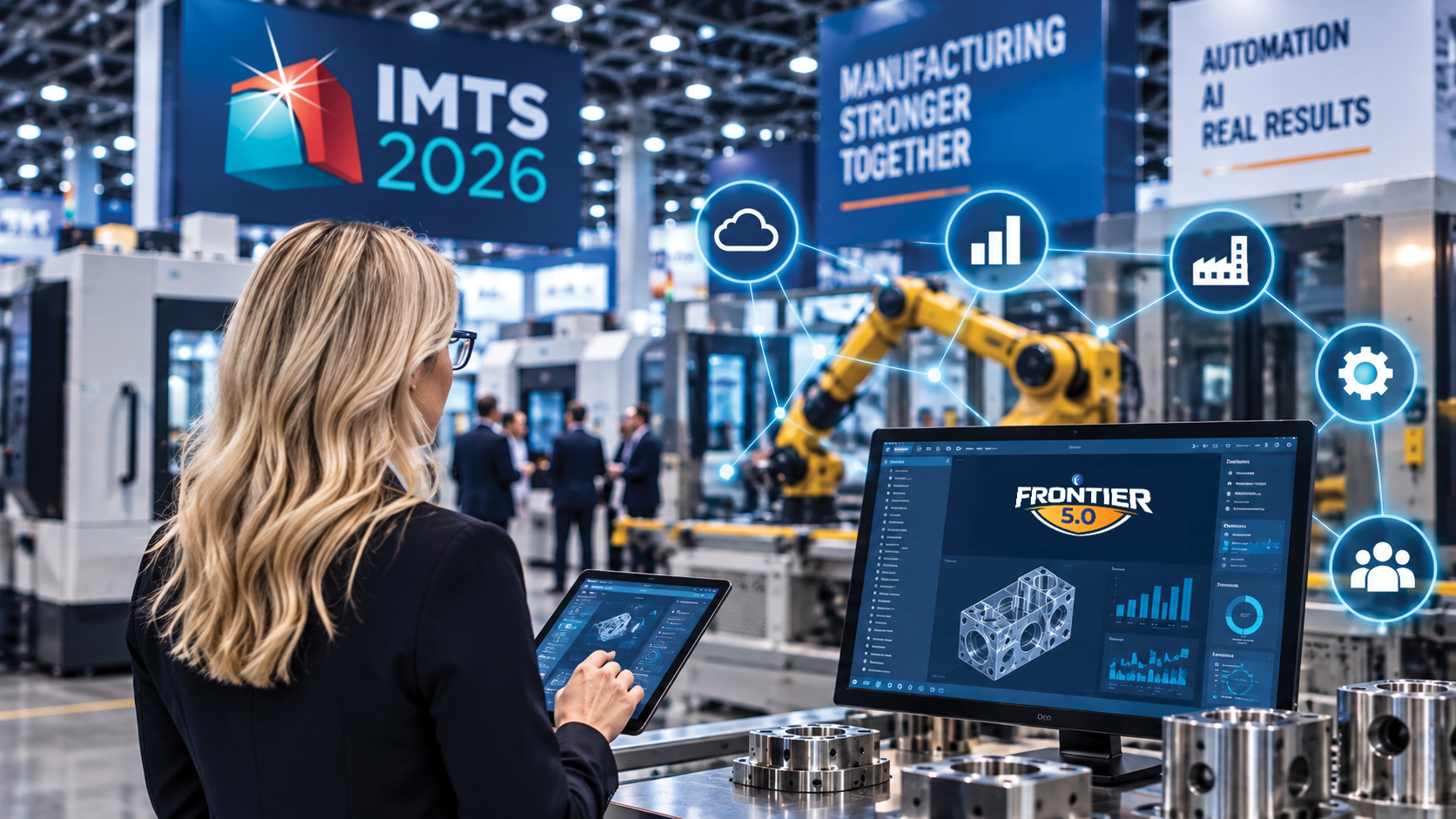
Walk through IMTS 2026 this week and you’ll see some of the most advanced manufacturing technology in the world.
Robotics.
Automation.
CNC equipment.
Digital engineering.
Additive manufacturing.
Metrology.
Artificial intelligence.
Each technology is impressive on its own.
But one of the bigger stories emerging from modern manufacturing isn’t about any single machine or application.
It’s about connecting them.
Manufacturers increasingly need information to move seamlessly between customer orders, engineering, materials, machines, production, inventory and financial systems.
That is the foundation of connected manufacturing, and it is becoming increasingly important as manufacturers pursue greater productivity, visibility and agility.
IMTS 2026 is demonstrating that shift throughout McCormick Place this week, with technologies focused on connecting material flows, automation, enterprise platforms and real-time operational information.
For manufacturers evaluating what’s next, the question isn’t simply:
What technology should we add?
It’s:
How do we make all of our technology work together?
What Is Connected Manufacturing?
Connected manufacturing is the integration of people, machines, software and operational data across the manufacturing lifecycle.
Instead of individual systems operating independently, information flows between functions such as:
- Sales
- Product configuration
- Engineering
- Purchasing
- Inventory
- Production scheduling
- Manufacturing execution
- Quality
- Shipping
- Financial management
The objective is to create a more complete and current view of the manufacturing operation.
For complex make-to-order manufacturers, that connection is particularly important because every customer order can introduce different configurations, materials, engineering requirements and production instructions.
1. Manufacturers Have Plenty of Data. The Challenge Is Connecting It.
Modern manufacturing generates enormous amounts of information.
Machines generate production data.
ERP systems contain customer, inventory and financial information.
Engineering applications contain product specifications.
Quality systems collect inspection results.
Scheduling systems manage production priorities.
The problem is that these systems don’t always communicate effectively.
When they don’t, employees often become responsible for connecting the information manually.
They:
- Re-enter data
- Update spreadsheets
- Send emails
- Reconcile reports
- Search multiple systems
- Verify which information is current
Connected manufacturing reduces these information gaps.
Instead of employees moving data between systems, integrated technology allows information to move more naturally through the operation.
2. Real-Time Visibility Is Becoming an Operational Requirement
Traditional manufacturing reporting often answers:
What happened?
Connected manufacturing helps answer:
What is happening right now?
Manufacturers increasingly need visibility into:
- Production status
- Material availability
- Work center capacity
- Open orders
- Inventory
- Scheduling
- Quality
- Delivery performance
That information allows managers to identify problems before they become missed customer commitments.
IMTS is highlighting this transition through smart-factory technologies that integrate automation, material movement and enterprise systems with real-time visualization and decision-making.
The value isn’t simply having more dashboards.
It’s shortening the distance between information and action.
3. Automation Delivers More Value When It Is Connected
Automation can significantly improve an individual manufacturing process.
But isolated automation still leaves gaps.
Imagine a highly automated production cell that doesn’t know:
- Which customer order has priority
- Whether required material is available
- Whether engineering changed the specification
- When the order must ship
- What downstream operation comes next
The equipment may be automated.
The process surrounding it may not be.
Connected manufacturing provides the business context surrounding automation.
That allows manufacturers to move toward workflows where customer demand, scheduling, materials and production execution work together rather than operating independently.
4. Industrial AI Makes Connected Data Even More Important
Artificial intelligence is one of the defining themes at IMTS 2026.
For the first time, IMTS is featuring a dedicated Industrial AI Conference, taking place today, September 16, focused on practical factory-floor applications. Topics include predictive maintenance, quality, edge versus cloud computing and how manufacturers can identify high-value AI opportunities.
But one of the most important lessons isn’t about AI itself.
It’s about data readiness.
IMTS’s industrial AI coverage identifies usable data as one of the critical barriers manufacturers face when adopting AI. The conference specifically addresses what machine-learning-ready manufacturing data looks like and how organizations can build measurable use cases around uptime, quality, cost and throughput.
That creates an important sequence:
Connected Data → Operational Visibility → Better Decisions → AI Opportunities
Manufacturers trying to skip directly to the final step may struggle.
AI needs context.
And ERP can provide much of that operational context.
5. ERP Is Becoming the Connection Point
ERP was traditionally viewed as the business system behind manufacturing.
Orders.
Purchasing.
Inventory.
Accounting.
Invoices.
Those functions remain critical.
But the role of manufacturing ERP is expanding.
Modern ERP increasingly connects customer demand with the processes required to fulfill it.
For make-to-order manufacturers, that can include:
Customer Order → Configuration → Engineering → Purchasing → Inventory → Scheduling → Production → Shipping → Financials
Frontier ERP is designed specifically for manufacturers that design, build, modify or assemble products to order, including make-to-order, configure-to-order, engineer-to-order and assemble-to-order environments.
When these processes share information through an integrated platform, ERP becomes more than a system of record.
It becomes part of the operational infrastructure of the factory.
6. Product Configuration Connects Customer Demand to Production
Connected manufacturing begins before anything reaches the shop floor.
For configurable manufacturers, it often begins with the customer order.
A customer may select:
- Dimensions
- Materials
- Components
- Features
- Finishes
- Hardware
- Options
Those choices have downstream consequences.
They affect engineering.
Materials.
Pricing.
Scheduling.
Production.
Frontier ERP places a rules-based product configurator at the center of the system, allowing manufacturers to centralize engineering logic and product specifications so only valid, buildable products move forward.
That creates a more direct digital connection between what the customer wants and what manufacturing needs to build.
7. Connected Manufacturing Can Help Address the Productivity Challenge
Manufacturing productivity is receiving significant attention at IMTS this year.
Recent IMTS coverage notes that sustaining manufacturing investment and expansion increasingly depends on improving productivity and translating technology investment into greater efficiency and competitiveness.
Connected systems can contribute by reducing work that doesn’t create customer value.
Consider the time employees spend:
- Searching for information
- Re-entering data
- Reconciling spreadsheets
- Checking order status
- Manually communicating updates
- Correcting information errors
These activities consume capacity without producing another product.
Connecting systems can help reduce that friction.
The result isn’t necessarily fewer employees.
It’s allowing skilled employees to spend more time on the work where their knowledge creates the most value.
What Does a Connected Manufacturing Strategy Look Like?
Manufacturers don’t need to replace every system simultaneously.
A practical connected manufacturing strategy can begin by identifying the largest information gaps.
Ask:
Where are employees entering the same information twice?
Duplicate entry often signals disconnected systems.
Which spreadsheets are supporting critical operations?
Spreadsheets may indicate that information isn’t flowing effectively between core applications.
Where does production wait for information?
Look at engineering approvals, material availability, scheduling and configuration.
Which systems contain overlapping information?
Determine which application should become the authoritative source.
How quickly can managers see a problem?
If operational issues appear in reports days later, greater real-time visibility may be needed.
Is our manufacturing data ready for AI?
Before implementing AI, determine whether operational data is accurate, structured and accessible.
These questions help shift the conversation from buying technology to improving operations.
Frontier 5.0: Building for More Connected Manufacturing
The direction behind Frontier 5.0 reflects many of these changes in manufacturing.
One Platform. Smarter Manufacturing. Stronger Business.
The objective is to help complex manufacturers create a stronger operational foundation by connecting critical processes across the organization.
That includes areas such as:
- Product configuration
- Order management
- Engineering
- Inventory
- Purchasing
- Production scheduling
- Manufacturing operations
- Financial management
- Business intelligence
As automation, AI and digital manufacturing continue advancing, the systems connecting those technologies become increasingly important.
Friedman Corporation Is Live at IMTS 2026
These aren’t theoretical conversations for us this week.
Friedman Corporation and Frontier ERP are currently exhibiting at IMTS 2026 at McCormick Place in Chicago.
IMTS runs through September 19, bringing together technologies across machining, additive manufacturing, automation, digital solutions, quality and industrial AI.
If you’re attending the show, stop by and talk with our team about:
- Frontier 5.0
- Make-to-order ERP
- Product configuration
- ERP modernization
- Production visibility
- Manufacturing execution
- Data integration
- Workflow automation
- AI readiness
- Connected manufacturing
Booth #135646
McCormick Place | Chicago, IL
September 14–19, 2026
Bring us the manufacturing challenge you’re trying to solve.
The best technology conversation often starts there.
Conclusion: Don’t Just Automate. Connect.
Manufacturing technology will continue getting smarter.
Machines will become more automated.
AI will become more capable.
Data will become more valuable.
But manufacturers will only capture the full value of those technologies when information can move across the organization.
That is why connected manufacturing matters.
The goal isn’t simply a smarter machine.
It’s a smarter manufacturing business.
And for complex make-to-order manufacturers, creating that connected operational foundation may be one of the most important steps toward what comes next.
Frequently Asked Questions
What is connected manufacturing?
Connected manufacturing integrates machines, people, software and operational data so information can flow across engineering, inventory, production, purchasing, customer orders and other manufacturing processes.
How does ERP support connected manufacturing?
ERP provides operational context by connecting customer orders, product configuration, materials, inventory, production, shipping and financial information within a common business environment.
Why is connected data important for manufacturing AI?
AI requires accurate and contextual data. Connected manufacturing systems can provide more complete operational information for analytics, predictive models and AI-assisted decision-making.
What is Frontier ERP?
Frontier ERP is Friedman Corporation’s cloud ERP platform for manufacturers that design, build, modify or assemble products to order, including make-to-order, configure-to-order, engineer-to-order and assemble-to-order businesses.
Is Friedman Corporation exhibiting at IMTS 2026?
Yes. Friedman Corporation and Frontier ERP are currently participating in IMTS 2026 at McCormick Place in Chicago. The show runs September 14–19, 2026.