
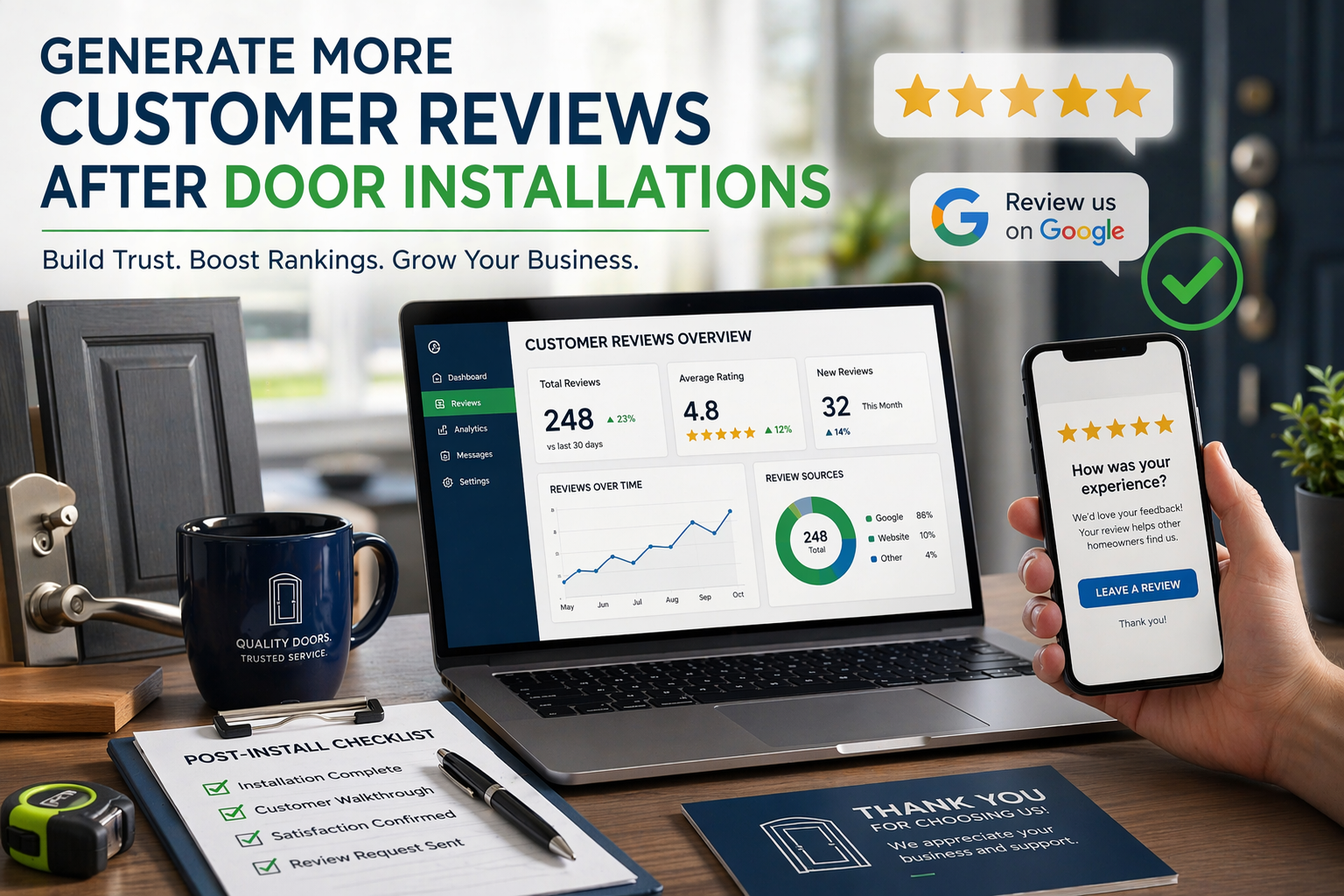
Generating more customer reviews after door installations is essential for any door company aiming to enhance its reputation and boost local search ranking. A well-structured review generation process not only improves customer satisfaction but also increases conversion rates and supports long-term business growth.
Whether you’re a regional door installer or a large-scale door manufacturer, the strategies below will help you build a consistent, scalable system for collecting the feedback that drives your business forward.
Why Review Generation Matters for Door Companies
Before diving into tactics, it’s worth understanding why customer reviews deserve a dedicated strategy — not just an afterthought.
Google reviews directly influence local search ranking. When prospective customers search for door installation services in their area, Google’s local algorithm weighs the quantity, recency, and quality of reviews when determining which businesses appear in the coveted “Local Pack.” A door company with 200 well-distributed reviews will consistently outrank a competitor with 20, even if the latter has a slightly higher average rating. Every new review is, in effect, a vote of confidence that the algorithm registers.
Beyond search visibility, there’s a compounding effect on buyer psychology. Studies consistently show that consumers trust online reviews as much as personal recommendations. For door companies — where projects involve significant investment, home security, and aesthetic decisions — that trust is especially important. A robust library of detailed, positive reviews answers objections before a prospect ever picks up the phone.
Finally, reviews feed your broader reputation management strategy. They signal to Google that your business is active and engaged, they provide social proof on your website and social channels, and they surface patterns in customer experience that help you continuously improve service quality. The door companies that treat review generation as a core business process — not a nice-to-have — are the ones compounding growth year over year.
Crafting a Seamless Post-Install Sequence
The single most common reason door companies fail to collect reviews is a lack of process. A happy customer who never receives a clear, convenient invitation to leave a review simply won’t. Building a structured post-install sequence removes friction and makes leaving a review the path of least resistance.
Start with a warm close. The final walkthrough with the customer — inspecting the installation, confirming satisfaction, and answering any remaining questions — is the emotional high point of the relationship. Train your installers to close this interaction warmly and to plant the seed: “We’d love to hear your feedback — we’ll send you a quick link.” This verbal primer makes the follow-up message feel expected rather than intrusive.
Timing is everything. Research across service industries consistently points to a 24–48 hour window as the sweet spot for review requests. Send too soon (while the installer’s truck is still in the driveway) and it can feel transactional. Wait a week and the enthusiasm has faded. A personalized message sent the morning after installation — when the customer is enjoying their new door and the experience is fresh — captures peak satisfaction.
Keep messaging short, personal, and direct. Your follow-up should:
- Open with a genuine thank-you by name
- Reference the specific project (“your new front entry door”)
- Explain briefly why the review matters (“it helps homeowners in [City] find trusted installers”)
- Include a single, prominent, direct link to your Google review page
- End with a low-pressure close — no urgency tactics, no incentives that could violate platform guidelines
A two to three sentence message consistently outperforms a long email. Customers are more likely to click a clear call to action than scroll through paragraphs of appreciation.
Multi-touch without being pushy. If the first message goes unanswered after three to four days, a single gentle reminder is appropriate. Frame it as a follow-up, not a pressure campaign. After two touchpoints with no response, move on — protecting the customer relationship matters more than any individual review.
Leveraging Marketing Automation to Request Reviews
Manually sending review requests after every job is unsustainable as your door company scales. Marketing automation is the bridge between having a great post-install sequence on paper and executing it consistently across hundreds of jobs per month.
How automation raises your review conversion rate. Automated review request tools — whether built into your CRM, your field service platform, or a standalone reputation management tool — trigger messages based on job completion status rather than someone remembering to send them. This eliminates the single biggest point of failure in most review programs: human forgetfulness. When every completed door installation automatically triggers a personalized follow-up within a defined window, your review volume grows proportionally with your job volume.
Personalization at scale. Modern automation platforms allow you to dynamically populate messages with customer name, project type, installer name, and job address. The result is a message that feels handcrafted even though it was triggered automatically. Customers respond to relevance — a message that references their specific installation is far more compelling than a generic “please review us” blast.
CRM integration makes the difference. For door manufacturers and larger installation companies using an ERP or CRM system, the real power comes from integrating review requests directly into the job completion workflow. When a job is marked “complete” in your system, the review request fires automatically. This creates a closed-loop process: job done → customer notified → review collected → data fed back into reporting. Platforms like Frontier ERP, which are purpose-built for door manufacturers, can support these integrations, connecting operational milestones with post-sale customer engagement.
Track what’s working. Automation also gives you measurable data. Monitor open rates, click-through rates on your review link, and conversion rates (clicks that result in a published review) by message variant, timing, and installer team. Use this data to continuously refine your sequence and improve results over time.
Enhancing Customer Experience to Boost Positive Feedback
No amount of clever messaging will generate strong reviews if the underlying customer experience doesn’t earn them. Customer satisfaction is the foundation that every review strategy is built on — and in the door industry, the details matter enormously.
Service quality starts before the installation. Clear communication during the quoting and scheduling process sets expectations accurately, which is the most important factor in customer satisfaction. A customer who knows exactly what to expect — timeline, process, cleanup, what to do if there’s an issue — is far less likely to be disappointed and far more likely to leave a positive review. Invest in pre-installation communication: confirmation emails, arrival windows, material and finish confirmations, and a direct contact for day-of questions.
The installation experience is your brand. Installers represent your company in a customer’s home. Punctuality, professionalism, cleanliness (especially post-installation cleanup), and a thorough walkthrough are not differentiators — they are table stakes. What creates memorable experiences, and the kind of enthusiastic five-star reviews that mention specifics, are the small extras: an installer who noticed a related issue and flagged it proactively, a team that left the work area cleaner than they found it, or a follow-up call from a manager a week later to make sure everything is functioning perfectly.
Small touches compound into great reviews. Consider building a short customer-delight checklist into your installation process:
- Leave behind a branded door care card with maintenance tips
- Confirm the customer has the warranty documentation they need
- Provide a direct contact for any post-installation questions
- Send a “30-day check-in” message asking if everything is still performing well
Each of these touchpoints signals that your relationship with the customer doesn’t end at job completion. That perception — that your door company genuinely cares about the long-term outcome — is exactly what customers describe in their best reviews.
Referral Programs and Reputation Management Best Practices
A strong review profile doesn’t just attract new customers organically — it creates a foundation for a high-performing referral program and an ongoing reputation management system that protects and amplifies your brand.
Turn happy reviewers into active referrers. Customers who take the time to leave a detailed, positive review have already demonstrated brand advocacy. These individuals are your best candidates for a structured referral program. Following up a positive review with a warm message that thanks them and introduces your referral incentive (a discount on future services, a gift card, or a charitable donation in their name) captures this goodwill at its peak. Referral-driven leads close at significantly higher rates than cold inbound leads — they arrive pre-sold by someone they trust.
Design referral incentives thoughtfully. The most effective referral programs for door companies offer value to both the referrer and the new customer. A tiered approach — where the incentive increases with each successful referral — encourages repeat advocacy rather than a one-time share. Keep the redemption process simple: a unique referral link or a name drop at the point of inquiry is sufficient. Complexity kills participation.
Reputation management is an ongoing discipline. Collecting reviews is only half the equation. How you respond to them — both positive and negative — signals to future customers and to search algorithms alike that your business is attentive and accountable.
For positive reviews: respond promptly, use the customer’s name, reference the project specifically, and thank them genuinely. This takes 30 seconds and dramatically increases the perceived authenticity of the review profile.
For negative reviews: respond calmly, acknowledge the concern without deflecting, and move the resolution offline (“Please reach out to us directly at [phone/email] so we can make this right”). A thoughtful, professional response to a negative review often impresses prospective customers more than a perfect score. It demonstrates maturity and a commitment to service.
Monitor consistently. Set up Google Alerts for your business name, monitor your Google Business Profile weekly, and use your reputation management platform to flag new reviews for prompt response. Patterns in negative feedback — whether about scheduling, cleanup, or communication — are valuable operational data. The door companies that treat review content as a feedback loop, not just a marketing metric, are the ones that continuously improve and consistently earn higher scores.
Conclusion
Consistent review generation is an integral part of a sustainable growth strategy for any door company. By focusing on effective post-install communication, automation, customer satisfaction, and proactive reputation management, businesses can build credibility, improve their local search ranking, and encourage more referral-driven sales.
The strategies outlined above aren’t one-time initiatives — they are systems designed to compound over time. Each new review strengthens your local search position, each satisfied customer becomes a potential referrer, and each operational improvement informed by customer feedback raises the quality of the next installation. Start with the fundamentals — a structured post-install sequence and an automated review request — and build from there.
For door manufacturers looking to connect their operational workflows with post-sale customer engagement, an ERP platform purpose-built for the door industry can serve as the connective tissue that makes these strategies scalable. Learn how Friedman Corporation’s Frontier ERP supports door manufacturers.
Frequently Asked Questions
What is the best way to ask for Google reviews after a door installation?
Requesting Google reviews after a door installation is most effective when done promptly through a structured post-install sequence. Send a personalized follow-up message within 24 hours, expressing thanks and briefly explaining how their feedback helps your door company improve. Include a direct link to your review page, making it as simple as possible. Automating this request, while maintaining a personal touch, optimizes response rates and supports your overall reputation management strategy. Clear communication and easy access are key to consistently generating new customer reviews.
How many reviews does a door company need to rank in Google’s local results?
There is no fixed number, as Google’s local algorithm weighs recency, relevance, and response rate alongside volume. However, businesses with a consistent, ongoing stream of new reviews — even a handful per month — tend to outperform those with a larger but stagnant review count. Focus on building a sustainable process rather than hitting a specific target.
Should I respond to every Google review my door company receives?
Yes. Responding to all reviews — positive and negative — signals to Google that your business is active and engaged, which supports local search ranking. It also demonstrates to prospective customers that you value feedback and take customer relationships seriously. Keep responses personal and specific rather than using templated replies.
Can I offer incentives for Google reviews?
Google’s guidelines prohibit offering incentives — discounts, gifts, or payment — in exchange for reviews. Doing so risks having reviews removed or your Business Profile penalized. You can, and should, ask customers to leave honest reviews, make the process easy, and follow up respectfully. Referral program incentives, which reward customers for bringing in new business rather than for writing a review, are a compliant way to leverage happy customers.
How does marketing automation improve review generation for door companies?
Marketing automation ensures that every completed installation triggers a timely, personalized review request — regardless of how busy the team is. This consistency is the most important factor in building review volume at scale. Integrated with your CRM or ERP system, automation also provides data on which messages, timing windows, and channels generate the highest conversion rates, allowing continuous optimization of your review generation process.